
Large loose seals: resolve a compact-pack shape proposal
Review a smaller seal package against the loose component’s required relaxed state before letting carton dimensions determine its shape.
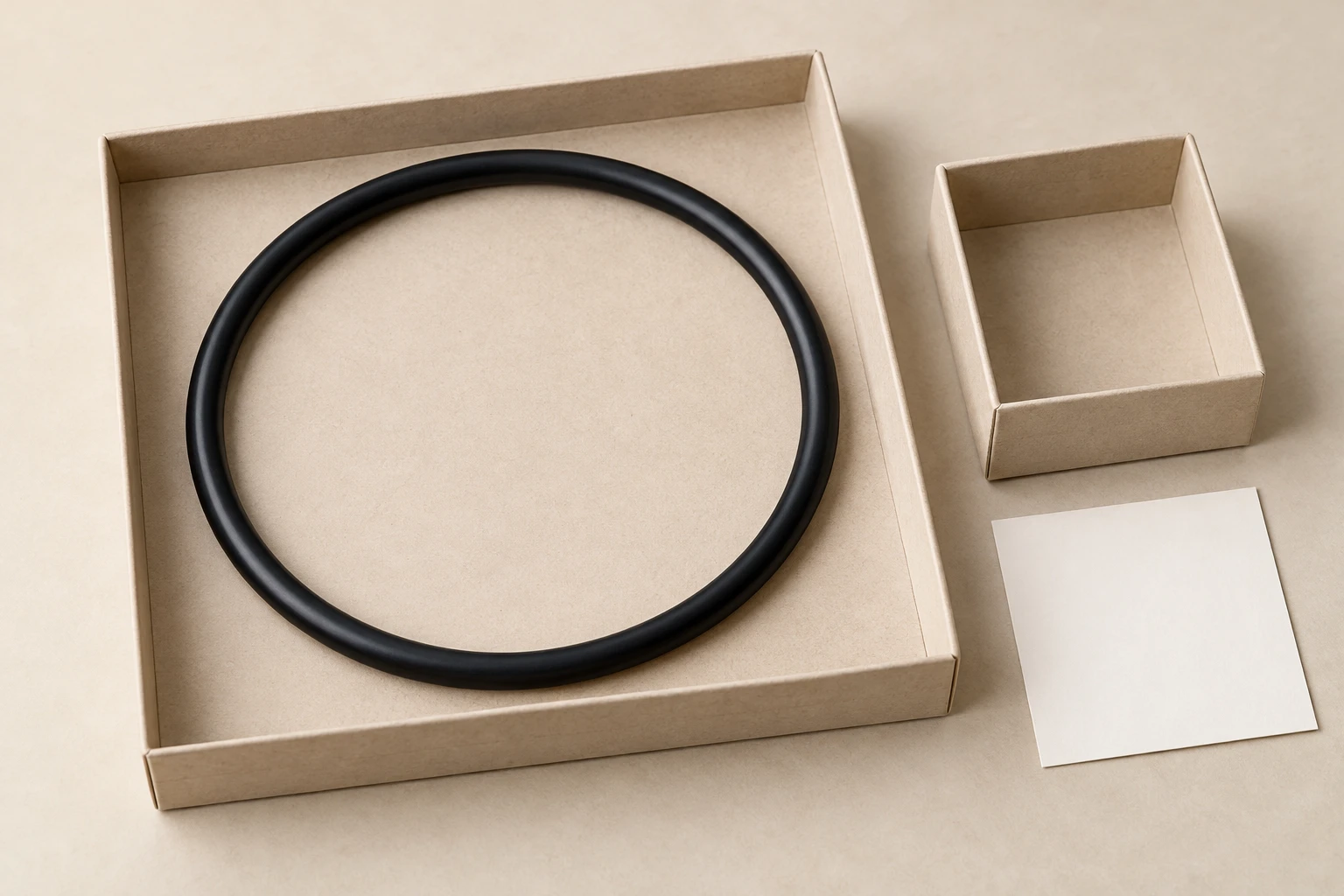
A compact package can change the supplied condition of a large loose seal even when its part number stays the same. If the proposal depends on bending, compressing or restraining the seal into a smaller space, obtain a product-specific answer before accepting the package dimensions. The package should follow the supported seal state rather than define it by convenience.
The seal and material should already be selected. This is a review of a proposed loose-component arrangement, not an instruction to reshape a seal or a diagnosis of a part that has arrived distorted.
Establish the loose state being packed
Hallite's storage guidance favors a relaxed rubber-item position without tension or compression. That provides a reason to question a compact proposal that relies on imposed strain; it supplies no universal permissible fold, bend radius or recovery period. Hallite storage of seals, deformation section
Identify the exact loose seal, its compound declaration and any applicable manufacturer packing information. Keep it separate from seals already fitted to a piston or other assembly. An installed seal's support condition needs assembly-specific review and cannot be resolved by this loose-part worksheet.
Ask the supplier to describe the state represented in its original offer and the state required by the revised package. Record the difference as a proposal. Do not ask someone to bend the real seal to demonstrate that it fits the new box.
Make the source of constraint visible
A smaller outside dimension is not a complete layout. Ask whether the proposed inner arrangement leaves the seal relaxed, applies a restraint, compresses its profile or relies on another item occupying the same space. The response should identify the actual relationship, without a buyer guessing forces from a rendering.
Separate seal geometry from empty-carton dimensions. A sales sketch can show the commercial objective while omitting the seal section or closure relationship. If the provider cannot describe the occupied state, the compact proposal is not sufficiently defined for the technical owner to assess.
The same distinction applies to several seals grouped together. Matching nominal diameter does not establish that different profiles can be nested or bound as one group. Preserve each approved reference and let the responsible provider define whether the proposed grouping is covered by its guidance.
Request alternatives without designing the pack
Ask the product provider which arrangements it supports for this seal and the intended transit or storage stage. Request an attributable response tied to the actual proposal revision. A statement that the item is flexible is not enough to settle its permitted packed state.
If the compact arrangement remains unsupported, ask the supplier for an alternative retaining the required state and its actual commercial terms. Do not prescribe a larger dimension, tie method, separator thickness or packing orientation yourself. The buyer can compare supported proposals without becoming the designer.
Keep any difference in storage use explicit. A kit expected to remain unopened as a spare needs that intended use included in the review. Do not invent a period after which the buyer should release a restraint or a time in which the seal will recover.
A fictional diameter-only sketch
A supplier sends a compact-kit sketch that represents a large loose seal as a thin circle beside a metal spare. The buyer's accepted item has a defined section, but the sketch does not show how that section or the closing lid is accommodated. The supplier says the seal will compress slightly.
Return the specific unanswered question: what supplied state does the layout impose on the actual seal, and which applicable provider response supports it? A matching nominal diameter does not resolve section compression. The buyer should not approve a physical trial merely to make the drawing convincing.
If the revised proposal retains the seal's supported loose state in a separate inner package, record that exact layout and its covered stage. No successful shipment, cost saving or sealing-performance result is implied by this fictional outcome.
Keep a loose-seal pack-state sheet
| Record field | Evidence to retain |
|---|---|
| Loose seal | Approved reference, section and compound declaration |
| Baseline state | Supplier or manufacturer record for the uninstalled component |
| Proposed constraint | Bending, compression, restraint or grouping introduced by the layout |
| Occupied layout | Evidence representing the actual seal section and closing relationship |
| Covered stage | Transit, unopened spare storage or unresolved intended use |
| Supported alternative | Provider response, accepted revision and remaining limits |
Approval should identify the exact component, inner layout and covered use. Later changes to profile, neighboring contents or closure relationship should return to the relevant owner for an applicability check. An unchanged SKU label cannot conceal a changed packed condition.
Bring the specific packing question into the inquiry
Use the Seals and gaskets category and Spareparts sourcing request to identify the approved item and exact proposed change. The site provides independent aftermarket/unbranded buying coordination and supplier negotiation. Manufacturer examples do not establish affiliation, original-equipment supply, specialist packing capability or engineering approval.
The initial form supports an eligible marketplace HTTPS link, an 8–1200-character description or screenshots. It accepts up to five PNG, JPEG, WebP or GIF images, at most 10 MiB each and 20 MiB combined. PDF, CAD and ZIP files need a separately agreed authorized exchange; the image field is not a technical-file portal.
Can flexibility justify a smaller seal box?
No. Obtain a response for the exact loose seal and proposed packed state. Flexibility does not supply an allowable compression or fold rule.
Does nominal diameter settle the fit in the package?
No. The actual profile and closure relationship can remain unresolved. Request a proposal representing the real component rather than a diameter-only sketch.
What recovery time should the supplier promise?
No recovery period is established here. Do not use an assumed rebound as permission for a strained package or as an acceptance criterion.
Does this worksheet cover seals installed on pistons?
No. Installed seals raise assembly-support questions. Preserve that state and obtain the appropriate assembly-specific provider assessment.
Sources
Discuss a sourcing request related to this article.Large loose seals: resolve a compact-pack shape proposal