
Bearing strip receipt: separate section from supply form
Reconcile bearing strip cross-section evidence and the ordered coil or cut-piece form without allowing extra length to substitute for the specified section.
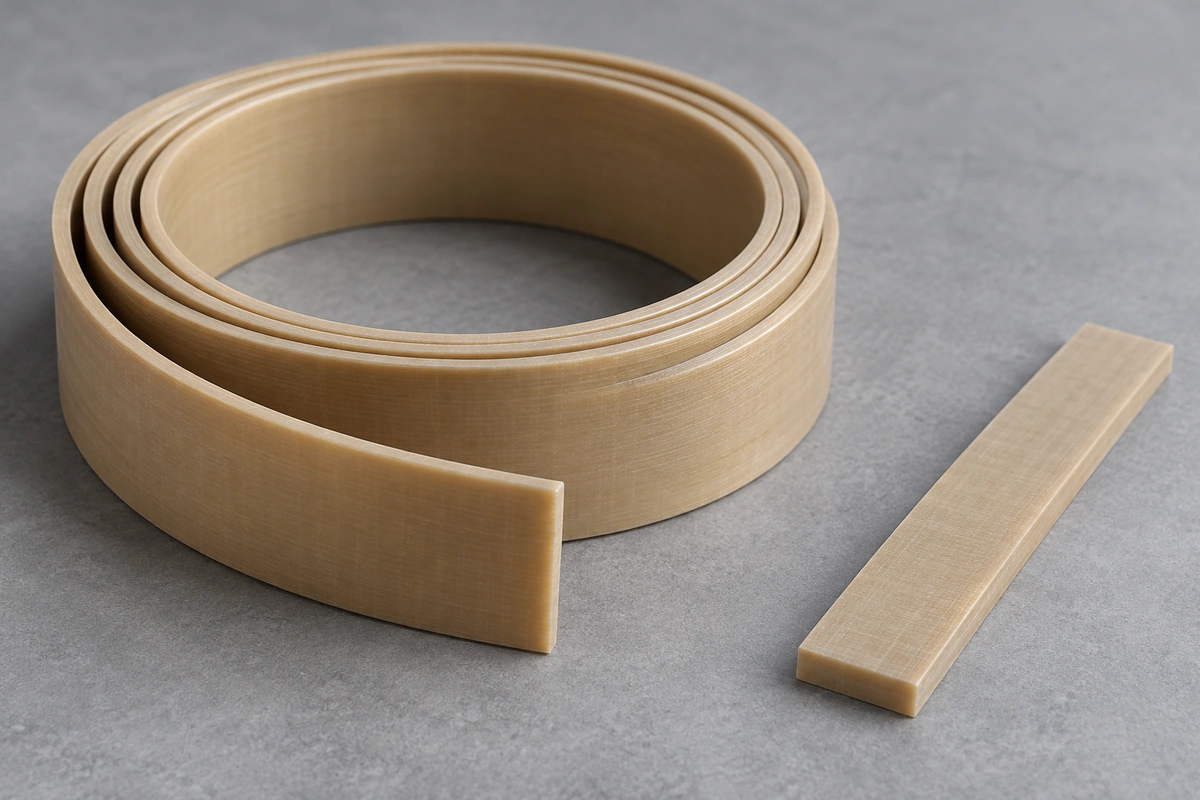
Extra bearing-strip length does not resolve an unanswered cross-section requirement. Nor does a section report establish that a shipment contains the ordered cut pieces. At receipt, keep product section, individual-piece requirements and commercial supply form separate before considering a supplier’s quantity-based remedy.
This article concerns the delivered buying scope. It does not calculate a bearing’s installed gap, define a cut length or instruct a buyer to convert strip into a finished bearing.
Identify what kind of supply was agreed
Hallite’s housing data describes different supply forms for its bearing strip, including spiral lengths, individually cut bearings and lengths packed flat. It separately labels bearing length L1 and bearing cross section S in its product-specific tables. That supports preserving form and feature labels, not borrowing table values as universal receiving limits. Hallite housing and installation data
Do not assume that the table’s “bearing length” means the circumference of a cut strip. Use the exact product drawing to define each required feature. An order’s commercial length, a drawing’s axial dimension and a cut-piece requirement can be different records even when each uses the word length.
Separate quantity compensation from geometry
Recover the accepted product designation, section drawing, supply unit and any agreed individual-piece definition. If the order calls for prepared pieces, identify the controlled piece drawing and quantity. If it calls for stock strip, preserve the ordered length basis and supplied form.
Ask the supplier’s section report to identify the actual drawing feature and covered population. Keep a supplied-length statement alongside it, not in its place. A seller’s offer of more material may address a quantity negotiation while leaving section conformity entirely unresolved.
If the proposed remedy changes cut pieces to a coil or flat strip, identify the newly required work and responsibility. Do not accept that as an equivalent delivery merely because the total material quantity is larger. A changed supply form may need a separate agreement on who provides the finished pieces and their evidence.
Section-and-form worksheet
| Field | Evidence to keep separate |
|---|---|
| Product reference | Exact strip type, material and governing drawing |
| Section requirement | Named cross-section features, units and accepted reference |
| Supplied form | Coil, spiral, flat length or individual cut bearings as actually agreed |
| Piece or length basis | Required quantity and any controlled individual-piece definition |
| Returned evidence | Section result and supply-quantity record, each with coverage |
| Proposed remedy | Which requirement the extra material or changed form actually addresses |
This worksheet should not contain an improvised conversion from rod diameter to strip length. If that design information is missing, it belongs with the responsible technical owner.
A fictional extra-coil offer
Imagine a fictional order for individually defined bearing pieces. The received section report does not address one drawing-defined section feature. The supplier offers additional stock strip and says the buyer will have plenty of material.
The offer may increase available material, but it neither answers the missing section result nor supplies the originally ordered finished-piece evidence. Ask for the report addressing the exact section feature. Treat the change to stock strip as a separate commercial and technical proposal.
If the order was actually for stock strip, do not demand finished pieces retrospectively. The same separation helps here: verify the agreed supply basis, retain the section question and request only the missing evidence within scope.
Close each decision with its own result. Quantity received, supply form agreed and section accepted can have different statuses. None establishes installed bearing performance or authorizes cutting, fitting or trial operation.
Prepare a bounded supplier question
Use the Seals and gaskets category and Spareparts sourcing request to identify the item and the unresolved question. Independent aftermarket or unbranded buying coordination does not establish manufacturer affiliation, original-equipment supply, inspection availability or technical approval. The manufacturer references above explain documentation; the fictional example is not a customer case.
The form supports a supported-marketplace HTTPS link, an 8–1200-character description, or screenshots. It accepts up to five PNG, JPEG, WebP or GIF images, at most 10 MiB each and 20 MiB combined. It does not accept PDF, CAD or ZIP uploads. Arrange other authorized technical files only through a separately agreed exchange.
Can extra length compensate for the wrong bearing strip section?
No automatic equivalence exists. Quantity and section answer different requirements, and any change needs an explicit technical and commercial decision.
Does the Hallite table’s bearing length mean cut circumference?
Do not assume that meaning. Preserve the label and use the exact product drawing to define the feature; commercial strip length is a separate field.
Is a coil equivalent to ordered cut bearings?
Only if a properly reviewed change is agreed. The supply form and responsibility for any remaining work must stay explicit.
Should receiving calculate and cut missing pieces?
This article provides no cutting or sizing method. Missing design or finishing scope must be resolved by the responsible owner and an authorized provider.
Sources
Discuss a sourcing request related to this article.Bearing strip receipt: separate section from supply form