
Rotary Union Returns: Confirm the Original Purchase Route Before Paying Freight
Recover the original seller and order classification before treating an unused rotary union as returnable stock.
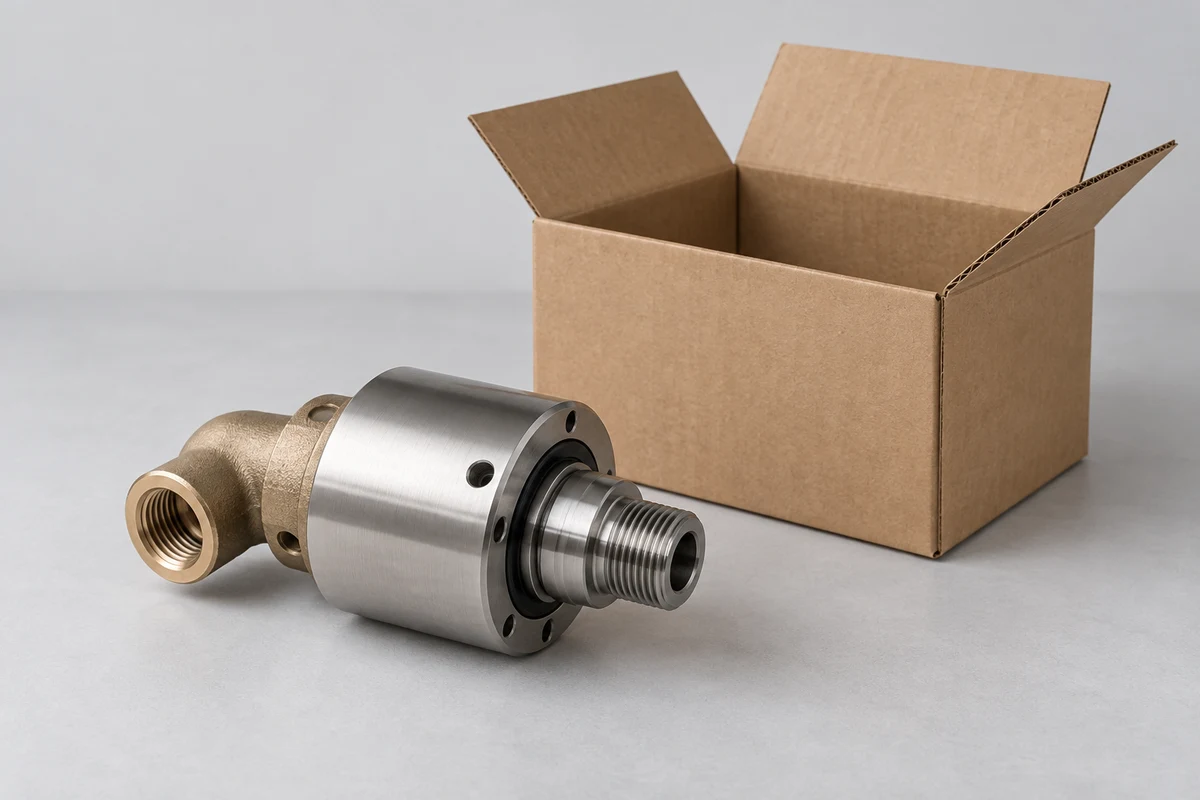
An unused rotary union can look like a standard catalogue item and still sit outside the proposed stock-return policy. Before paying return freight, connect the physical item to its original purchase record and obtain a decision for that transaction. A current catalogue match does not rewrite the way the unit was originally supplied.
This matters when a spare remains after a machine project changes or an order is cancelled internally. There need not be a product defect. The first buying question is whether an unwanted-stock return route exists for this particular order, not how much credit a box shipped without authorization might recover.
Recover the transaction behind the part
Start with the invoice, seller identity, purchase reference, model and quantity. Retain any special-order notation, agreed modification or customer-specific drawing reference. If someone bought through a distributor or marketplace intermediary, identify that seller instead of assuming the manufacturer's direct-purchase policy applies.
Deublin's end-user return conditions distinguish direct purchases of new, unused, normally stocked products in original packaging from custom or made-to-order items. Its page directs the buyer to customer service to confirm classification. That is a named provider's policy, not evidence that another seller accepts the same return.
Record the original order description beside the current catalogue description. A later listing may help identify a question, but the seller must resolve a classification mismatch. Do not remove a special-order suffix or describe a modified unit as standard to fit the simpler route.
Keep condition and classification separate
Ask the actual seller what condition evidence it needs. Preserve the existing packaging and attributable records while the question is open. A photograph of a clean exterior is not a complete statement about prior use, and purchasing should not infer unused status from appearance.
Classification and condition are different gates. A demonstrably unused special-order item may still be excluded from a stock-return programme. Conversely, establishing that a model is standard does not establish the condition, purchase age or original seller required by a particular policy.
DSTI's return policy also separates new, unused standard rotary unions from custom products and electrical components. Its repair process is described separately. A repair-evaluation reference should therefore not be treated as a promise of unwanted-stock credit. Ask the provider which route it is actually offering.
Obtain the decision before the shipment
Send the seller a bounded request: identify this order, this quantity and the documented condition, then ask whether an unused-stock return can be considered. Preserve the response and any conditions. If a missing invoice or classification confirmation prevents a decision, resolve that evidence question before buying carriage dependent on acceptance.
Once a route is offered, obtain its recipient, authorization reference, expiry if any, assessment conditions and commercial recovery terms. Ask which freight movements the buyer must pay. An instruction to prepay carriage identifies a transport obligation; it does not fix the eventual credit or remove the seller's stated evaluation conditions.
Original purchasing worksheet
| Record | Evidence to retain |
|---|---|
| Original transaction | Actual seller, purchase reference, date and quantity |
| Supplied classification | Standard, custom or made-to-order response for that order |
| Current condition | Attributable unused-status and packaging evidence requested by seller |
| Proposed route | Stock return, other offered remedy or unresolved request |
| Authorization | Named receiver and order-specific permission with conditions |
| Financial exposure | Quoted carriage and confirmed recovery basis, with blanks visible |
These are correspondence fields, not a manufacturer's mandatory form. Do not prefill unknown classification or credit amounts to make the table look complete.
Fictional example: a standard-looking special order
A fictional buyer has one surplus union whose visible shape resembles a current catalogue photograph. The original order includes a special supply reference. The buyer initially plans to pay postage using the catalogue listing as proof of eligibility.
Instead, the buyer asks the original seller to identify the supplied classification. If the seller confirms it was a special-order item outside its stock-return route, that branch closes unless a separate written proposal is offered. The buyer has avoided committing freight to an unsupported remedy; no refund, saving or alternative service is assumed.
Keep the seller's answer with the order even if the item later appears under a different catalogue description. Return eligibility and suitability for another machine remain separate decisions. This purchasing record establishes neither compatibility nor permission to alter the union.
Bring a defined question to the supplier
See Spareparts product context for the relevant buying category. Use the Spareparts sourcing enquiry to describe the exact item and unresolved commercial question. Spareparts provides independent aftermarket and unbranded buying coordination and supplier negotiation. The named manufacturers are documentary examples, not affiliations or a claim that Spareparts supplies their branded products or services.
Frequently asked questions
Does a current catalogue listing prove my union is returnable?
No. Connect the unit to its original transaction and ask the actual seller to confirm the supplied classification and relevant return conditions. Catalogue resemblance alone does not resolve a special-order history.
Can unused custom stock use the normal return route?
Only if the responsible seller explicitly offers that route. Unused condition does not override a custom or made-to-order exclusion. Keep condition and classification as separate questions.
What if the part was bought through an intermediary?
Start with the actual selling party and its order record. A manufacturer's direct-purchase policy does not automatically establish rights or procedures for an intermediary sale.
Does paying return freight secure a credit?
No. Establish authorization and the actual recovery conditions first. Carriage payment does not settle assessment, deductions or the eventual remedy.
Sources
Discuss a sourcing request related to this article.Rotary Union Returns: Confirm the Original Purchase Route Before Paying Freight