
Retaining-ring RFQ: shaft, housing and groove identity
Connect the retaining-ring designation to the shaft or housing application and released groove drawing. Keep preliminary candidates separate from approval.
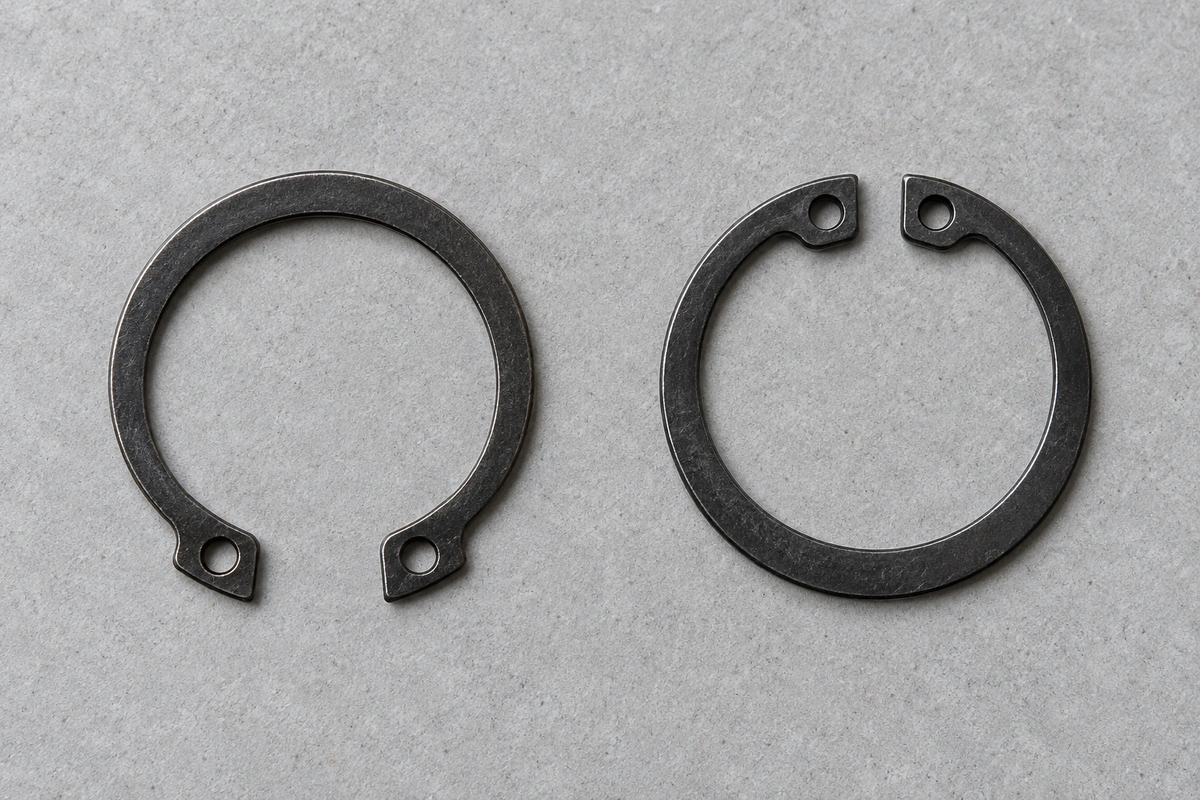
A retaining-ring quote must identify shaft or housing use, the nominal-size basis and the released groove. A loose ring diameter or repeated catalogue size does not establish a compatible replacement.
Give incomplete records a preliminary-candidate status
Standard-part catalogues can make a ring look easy to reorder, but the nominal application and groove remain part of the requirement. Ask for a candidate quotation when those records are incomplete, with the technical hold written beside the price.
| Inquiry state | Useful commercial response | What it must not become |
|---|---|---|
| Released groove and exact ring code available | Quote the specified variant and quantity | Permission to change the groove |
| Shaft/housing known, ring family uncertain | Return model-specific candidate and groove data | Accepted interchangeability |
| Loose ring only | Request assembly records and define identification scope | An order based on free-state resemblance |
Include the material/finish requirement and packaging quantity, especially when a seller prices a pack while stores need individual rings. State whether the request covers a ring alone or a defined kit. Those quantity questions do not settle load, speed or fit.
If a source proposes another ring family, preserve its exact designation and the documented interface differences for the buyer’s reviewer. A buying agent can collect this information and offers from suppliers; groove repair, installation and retention-duty approval remain separate professional tasks. The table is an original RFQ aid and supplies no installation recipe or numerical capacity.
The RFQ should connect the proposed ring designation to the actual retention requirement. The buyer is asking for a documented candidate, not selecting a ring by stretching, compressing or trial-fitting an unidentified sample.
Name the application before the diameter
Smalley’s retaining-ring overview distinguishes internal rings for housings from external rings for shafts. That is the first distinction to preserve in a quotation. It does not imply that every ring of a given nominal size shares a groove or load capability. Smalley retaining rings
Write “shaft application” or “housing application” using the approved assembly record, then attach the nominal size and units. Ask the supplier to confirm what its catalogue diameter means for the specific ring family. Do not move a free-state measurement into the nominal-size field because the values seem close.
If the application is unclear, request the relevant assembly view from the technical owner. A cropped photograph of a loose ring may not reveal the intended interface, and this inquiry does not call for dismantling machinery to settle it.
Keep the groove drawing with the ring requirement
The released shaft or housing drawing should identify the relevant groove and its specified geometry. Reference that drawing and feature in the RFQ instead of asking a supplier to quote “a ring for this diameter” without the interface definition.
Separate as-found measurements from released requirements. Wear, damage or a previous modification may make the existing groove different from the approved record. Have the responsible engineer decide what that means; do not change the nominal drawing or machine the groove to suit an available ring on the buyer’s initiative.
A different ring family needs a documented comparison. Ask for the proposed manufacturer’s ring and groove data and the exact differences from the released arrangement. The fact that both products are described as retaining rings does not establish a common interface.
Request the duty evidence without inventing capacity
Have the technical owner supply the applicable duty and acceptance requirements. A catalogue’s general description should not be converted into an axial-load or speed approval for the actual assembly. Request model-specific information and the responsible review where those questions matter.
Material and surface requirements should remain visible alongside the dimensional comparison. A supplier should identify an offered variant fully rather than responding with a generic image covering several materials or series.
This is distinct from the laminar-seal purchasing question. Here the record links a retaining ring to a shaft or housing groove and the documented retention duty. A laminar ring’s labyrinth arrangement and ring-set count do not resolve that decision.
A fictional ambiguous size request
A buyer sends an RFQ for a nominal-size retaining ring without naming shaft or housing use. One supplier quotes an external ring; another quotes an internal ring. Both repeat the requested size in their offer titles.
The repeated size does not make the products alternatives. Return to the assembly record, identify the application and released groove, then reissue the requirement. Do not choose whichever free ring looks closer to the old part. The example intentionally supplies no dimensions or installation advice.
Use a groove-linked worksheet
| Record field | What the buyer should preserve |
|---|---|
| Shaft or housing | Approved external-shaft or internal-housing application stated explicitly |
| Released groove drawing | Drawing revision and groove feature reference, with as-found changes separate |
| Nominal diameter basis | Application size and units, not an unqualified loose-ring measurement |
| Ring designation | Exact family, material and variant offered by the supplier |
| Documented duty | Technical owner’s retention and operating requirements with supporting data |
| Review status | Interface comparison, unresolved condition and approval for the exact candidate |
If the released drawing is unavailable, the worksheet should show the technical hold plainly. A quotation can still be collected as a preliminary candidate, but it must not be represented as an accepted replacement.
Carry the interface identity into the order
“Please quote the retaining ring for the shaft or housing application identified in our drawing. Confirm the nominal-size basis, exact ring designation, material variant and applicable groove reference. Provide a separate documented comparison for any different series or geometry.”
Use the machined-parts sourcing category and spare-parts inquiry to organize the evidence. Ring installation, groove repair and load or speed assessment need the applicable manufacturer’s guidance and competent technical responsibility; no generic method or limit is supplied here.
AI-assisted editorial update, 26 October 2026. Sources and bilingual wording were checked with AI assistance; technical acceptance remains with the responsible provider.
Related purchasing decisions: One-off and batch order scope.
Frequently asked questions
Can a loose ring measurement define nominal size?
Not without the specific family’s size basis and application record. Preserve as-found measurements separately.
Can an alternative ring be ordered before groove review?
It may be quoted as a conditional candidate. It must not be represented as an accepted replacement while the interface decision is open.
Should a buyer modify the groove to match available stock?
This article does not authorize that. Any repair or design change needs the responsible technical review and applicable manufacturer guidance.
Sources
Discuss a sourcing request related to this article.Retaining-ring RFQ: shaft, housing and groove identity
Prepare a clearer buying request
Keep this page as context. Add what you know; review everything before sending. No purchase is made at this step.
Edit the checklist below before continuing. It stays a planning note; it does not approve a product or order.
- Shaft or housing
- Released groove drawing
- Nominal diameter basis
- Ring designation
- Documented duty