
Slip-ring receipt: is the reported noise the specified contact effect?
Distinguish angular path-resistance variation from contact noise on the same slip-ring circuit before deciding which requirement a report can address.
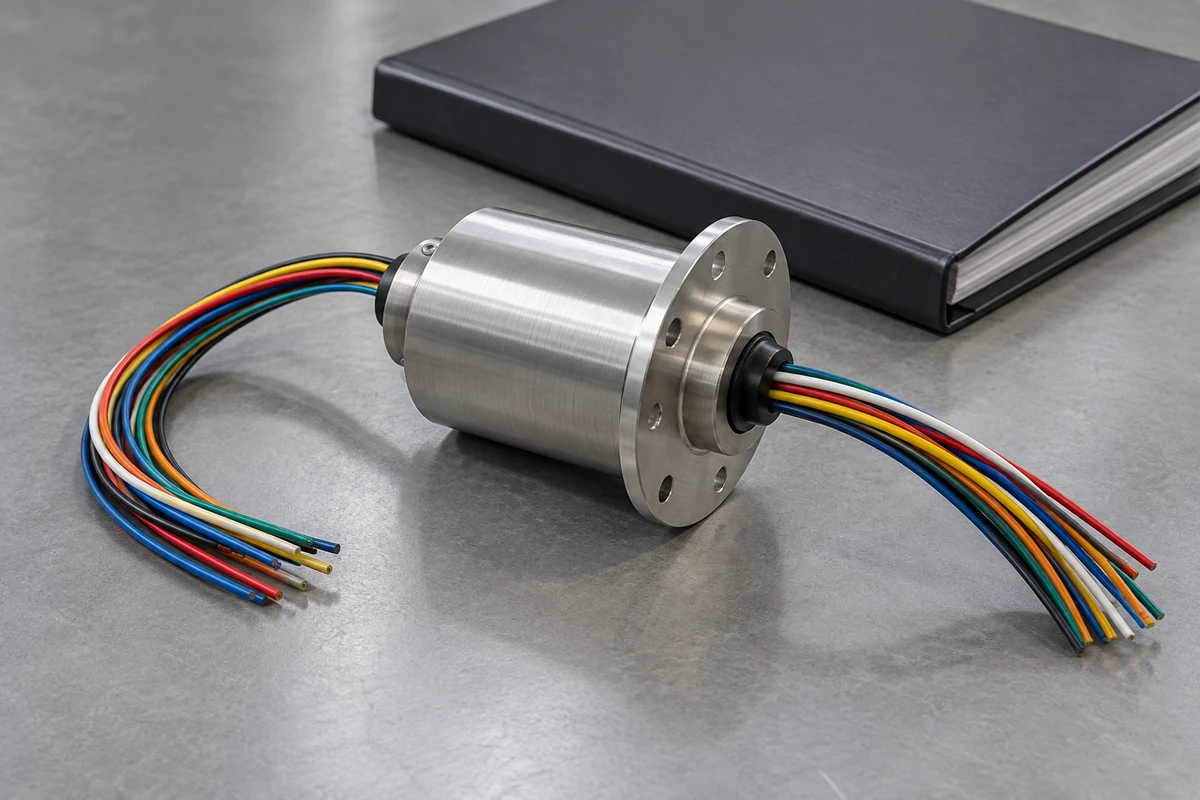
Suppose a fictional slip-ring report identifies the correct unit and circuit, and its cover note calls the result “noise.” The result's governing definition, however, describes maximum end-to-end resistance and expressly excludes contact noise. If the accepted requirement calls for contact noise, the report cannot close that requirement merely because its identity and paperwork are complete.
Start with that already identified circuit. The receiving decision is which physical question the submitted resistance evidence answers: resistance along the path, variation associated with angular position, or variation arising at the sliding contact. It is not a new circuit-function map or a count of missing report pages.
Separate angular path effects from contact changes
SPINNER's TD-00021 glossary defines terms used in its own technical documents. Its end-to-end resistance concerns the path between stator and rotor terminals; its maximum end-to-end figure excludes contact noise. It links resistance variation with rotation to periodic changes in circuit length and angular position. It separately attributes contact noise to microscopic changes in the contact surface area between the ring and sliding contact. These are different physical explanations for evidence on the same circuit. SPINNER TD-00021, Issue O, printed pages 1 and 21–22
The distinction matters when a report contains an angle-related result and the order asks about contact fluctuations. Identifying variation during rotation does not, by itself, tell the buyer which effect the reported quantity includes. Likewise, a maximum path-resistance result does not become contact-noise evidence when someone changes its summary heading. Use the governing product and report definitions, not a general assumption that all changing resistance is the same noise.
The cited glossary is a maker-specific example. Establish which definition and revision govern the actual purchase, especially when the supplied unit or report comes from another maker. This article does not impose SPINNER terminology universally or set a frequency boundary for classifying an unknown record.
Assign the supplied result to its own physical question
Copy the accepted resistance requirement and governing definition into the receipt record. Keep the submitted result's original name, unit, source definition and explicit exclusions alongside it. Preserve the report unchanged; a clearer buyer summary must not silently expand what was measured or reported.
Ask the report author which documented quantity the result represents. Where its definition excludes contact noise, record that exclusion plainly. The evidence may still support a separately specified end-to-end resistance question, subject to the technical owner's review. It leaves the contact-noise requirement open rather than proving that the unit passed or failed it.
An angle-related variation result needs the same discipline. If the source definition addresses the circuit-length effect, do not relabel it as the microscopic-contact result. A request for the required contact-noise evidence should cite the accepted definition and the supplied record's different physical scope. That gives the provider a precise question without instructing anyone to conduct a test.
If the order itself uses “noise” without a resolvable definition, keep the requirement unresolved. Ask the technical owner to establish the intended phenomenon and applicable basis before judging adequacy. Do not infer a missing definition from a favorable value, a waveform's appearance or another maker's terminology.
Compare conditions only after the phenomenon matches
When both records genuinely concern the specified contact-noise quantity, comparability becomes the next question. SPINNER notes that measurement conditions influence this value and that storage duration and run-in condition may also matter. The appropriate purchasing action is to preserve the provider's documented method and unit-state context for qualified review. SPINNER contact-noise discussion, printed page 22
Request the applicable method reference and recorded conditions needed to interpret the supplied result. Keep reported storage and run-in status as history, with unknowns explicitly left unknown. A shipping date is not a complete storage record, and a different recorded state is not proof of degradation.
If two contact-noise reports describe different states or conditions, do not select the smaller result and discard the other. Ask the responsible electrical reviewer whether they address the same acceptance basis and which evidence remains necessary. This review does not recommend running the unit to alter its state, changing filters or obtaining a more favorable reading.
Keep a phenomenon-to-requirement worksheet
| Field | What the decision needs |
|---|---|
| Same circuit and unit | Already resolved unit, configuration and circuit references |
| Ordered phenomenon | Exact resistance or contact-noise requirement with its governing definition and revision |
| Submitted quantity | Original result name, unit, report definition and explicit exclusions |
| Physical question answered | Path resistance, angle-related path variation, contact fluctuation or unresolved, based on the documentation |
| Recorded context | Method reference and provider-reported conditions and unit state; missing history remains unknown |
| Requirement decision | Named requirement the evidence can address, remaining gap, technical reviewer and next authorized evidence scope |
Use three distinct outcomes. “Addresses the required phenomenon” means the record is ready for the remaining comparability and acceptance review. “Addresses a different phenomenon” preserves useful evidence while leaving the specified requirement open. “Definition unresolved” identifies a requirement or report-meaning question that must be settled first. None of these labels substitutes for the qualified acceptance decision.
Follow the excluded-contact-noise case to its conclusion
In the fictional opening case, the required contact-noise definition and the submitted maximum end-to-end definition are both available. The latter expressly excludes the required effect. The buyer can therefore identify the evidence gap without alleging faulty contacts, a failed test or missing service work.
Ask for the existing attributable evidence addressing the specified contact-noise requirement, or confirmation that further evidence needs an agreed scope. Retain the maximum end-to-end report under its own quantity. Reissuing that same result with “contact noise” on the cover would not resolve the exclusion.
If a later genuine contact-noise report arrives but records a different unit state, the physical-quantity gap may be resolved while comparability remains open. The reviewer must decide its relevance against the governing requirement. Record that limited progress rather than treating every new attachment as a complete receipt release.
Close the electrical evidence decision within its scope
Retain the circuit identity, governing requirement, report reference and responsible decision together. State any remaining limitation or separately authorized evidence request. Resolving this resistance question does not establish data-protocol performance, electrical suitability, installation readiness or approval to operate the assembly. No wiring, energizing, rotation, run-in procedure or acceptance threshold is provided here.
The machined-parts category and Spareparts sourcing request can provide the purchasing context for a specific evidence question. Independent aftermarket or unbranded buying coordination does not establish manufacturer affiliation or electrical approval.
Start with a supported marketplace HTTPS link, an 8–1200-character description, or screenshots. The form accepts up to five PNG, JPEG, WebP or GIF images, no more than 10 MiB each and 20 MiB combined. PDF reports, CAD and ZIP files are not image-field uploads; use a separately agreed authorized exchange for those documents.
Can maximum end-to-end resistance close a contact-noise requirement?
Not where the governing definition expressly excludes contact noise, as SPINNER’s cited definition does. Retain the result for its own quantity and request evidence addressing the specified contact-noise phenomenon; the mismatch alone does not prove a defective unit.
Is every resistance change with angle contact noise?
Do not infer that from rotation alone. Determine whether the report’s definition addresses the angular circuit-path effect or the sliding-contact phenomenon. Ask the report author and qualified reviewer to resolve ambiguous terminology rather than relabeling the result.
What if two genuine contact-noise reports record different unit states?
Preserve both records and their method and state context. The qualified reviewer must decide comparability against the actual requirement. A different storage or run-in record is neither a damage diagnosis nor permission to change the unit’s state.
Does an accepted contact-noise result establish data compatibility?
It settles only the requirement covered by the responsible decision. Data-protocol performance, electrical suitability and installation or operating approval need their own applicable evidence and qualified review.
Sources
Discuss a sourcing request related to this article.Slip-ring receipt: is the reported noise the specified contact effect?