
Disc-spring RFQ: specify force and deflection together
Keep disc-spring dimensions, the approved force-at-deflection point and permitted deviation together when comparing replacement offers.
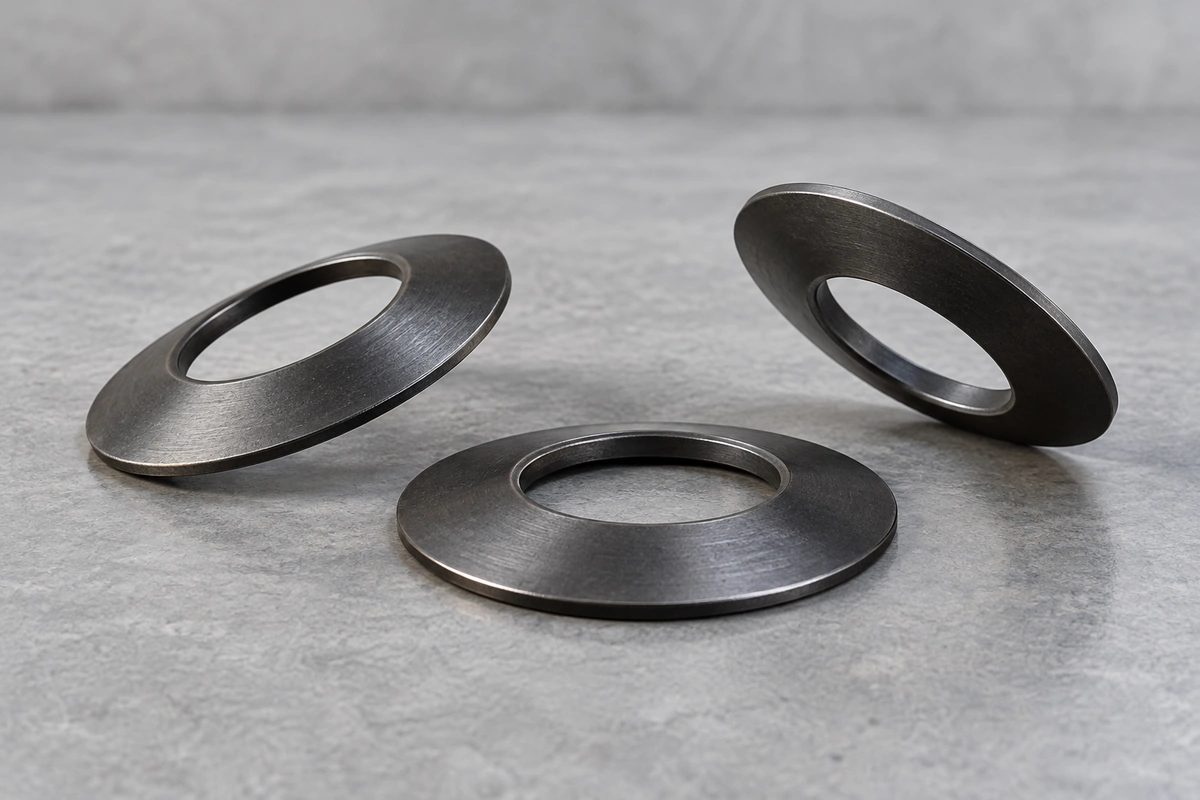
A disc spring quotation that gives a force without its associated deflection leaves the central purchasing question unanswered. The buyer needs a response to the approved operating point, not simply a disc with the same outside diameter or an impressive load figure.
Begin with the released part drawing or the equipment manufacturer's replacement record. If the only evidence is a removed spring, describe it as an identification sample. Its present shape does not establish the original load requirement, and the RFQ should not ask a seller to reconstruct that requirement by guesswork.
Read dimensions and loaded data as different fields
SCHNORR's standard-disc-spring product finder separates ordering dimensions from paired deflection s and force F entries. That is a useful documentary example of why a force value belongs with a stated deflection. It does not approve any catalogue spring for the reader's machine. SCHNORR standard disc springs
Keep outside diameter, inside diameter, thickness and the drawing's height references under their original labels. Do not rename free height as deflection or subtract measured dimensions to create a new load point. Ask the technical owner to identify the requirement that the quotation must answer, including units and any specified material condition.
If the drawing calls for more than one operating point, retain every point. A seller's confirmation at one position does not answer an omitted second position. Likewise, a catalogue nominal value and a contractual acceptance range are different pieces of information; request the actual permitted deviation rather than inventing a percentage.
Ask for a paired response
Present the requirement and proposed response in adjacent fields: required deflection and force, offered deflection and force, source document, and unresolved difference. This lets a reviewer see whether a supplier has answered the same condition or substituted a more convenient catalogue point.
Have the supplier identify whether its response is published catalogue data, a calculation or a proposed verification result. These evidence types should not be silently exchanged. If verification is required, the responsible specialist must define the method and acceptance criteria; a buying inquiry is not a spring-testing procedure.
A loose spring and an assembled stack are also different supply items. If the equipment record specifies an assembly, preserve its identifier and quantities without designing a new stack arrangement. Do not multiply a single-disc number into an assembly claim in the purchasing sheet.
A fictional offer with the right diameter
Suppose Offer A lists the requested outside diameter and a force figure but provides no deflection. Offer B returns the required geometry and a force at a different deflection. Neither response yet answers the operating point in the released requirement. This is an invented quotation comparison, not a test or a customer case.
Ask A for the paired value and its source. Ask B for a response at the required condition, or an explicitly separate alternative for engineering review. A lower price from B is not evidence that the changed condition is acceptable. If the supplier cannot answer, retain that limitation instead of filling the blank from a visually similar catalogue row.
Use an operating-point worksheet
| Record field | What the buyer should preserve |
|---|---|
| Drawing revision | Released part or assembly reference; distinguish a sample observation from a requirement |
| Disc dimensions | Outside and inside diameter, thickness and height references with their original labels |
| Force and deflection pair | Each approved force value tied to its deflection, units and stated condition |
| Material condition | Exact specified grade and condition, with proposed changes identified |
| Permitted deviation | Approved acceptance limits and evidence basis; leave unspecified limits open |
| Technical approver | Named owner and decision reference for the exact proposed spring |
Keep each drawing revision and supplier reply together. Mark a row as confirmed only when the reply identifies the required condition and the reviewer accepts the evidence; use unresolved where the value, definition or approval is missing.
Carry the approved point into the order
A concise inquiry can say: “Please quote the disc spring against the referenced drawing, including all specified dimensions and material condition. Return the force with its corresponding deflection and units for each required point. Identify your evidence and all deviations. Quote any different operating point or assembly arrangement separately for approval.”
The final order should retain those paired requirements, not collapse them back into “disc spring, size as sample.” Record the agreed identity and documentary checks separately from any technical acceptance work. Matching an order label does not establish the spring's service performance.
Use the machined-parts sourcing category for the purchasing context and the spare-parts inquiry to start a document-based request. Share only drawings you are authorized to disclose. Force selection and application approval remain with the responsible technical owner.
The inquiry image field accepts up to five PNG, JPEG, WebP or GIF files, no more than 10 MiB each and 20 MiB combined. A supported marketplace link, a short description or screenshots can start the request. It is not a PDF, CAD or ZIP upload field; arrange other technical files through a separately agreed, authorized exchange.
Is a matching outside diameter enough to quote a disc spring?
It is only one geometry field. The quote must also answer the released dimensions, material condition and required force at its stated deflection.
Can I compare two force figures if no deflection is given?
Not as equivalent operating-point responses. Ask each supplier for the associated deflection, units, conditions and supporting document before comparison.
Can a worn spring establish the original force requirement?
Treat it as identification evidence. The technical owner must recover or define the approved requirement rather than infer it from the used shape.
Does this worksheet specify a spring stack?
No. Preserve an existing approved assembly reference where applicable. Stack design, verification methods and application acceptance need separate technical responsibility.
Sources
Discuss a sourcing request related to this article.Disc-spring RFQ: specify force and deflection together