
Loose seal receipt: document storage distortion
Record a loose seal’s compressed or flattened arrival state without turning hand reshaping or a later appearance into acceptance evidence.
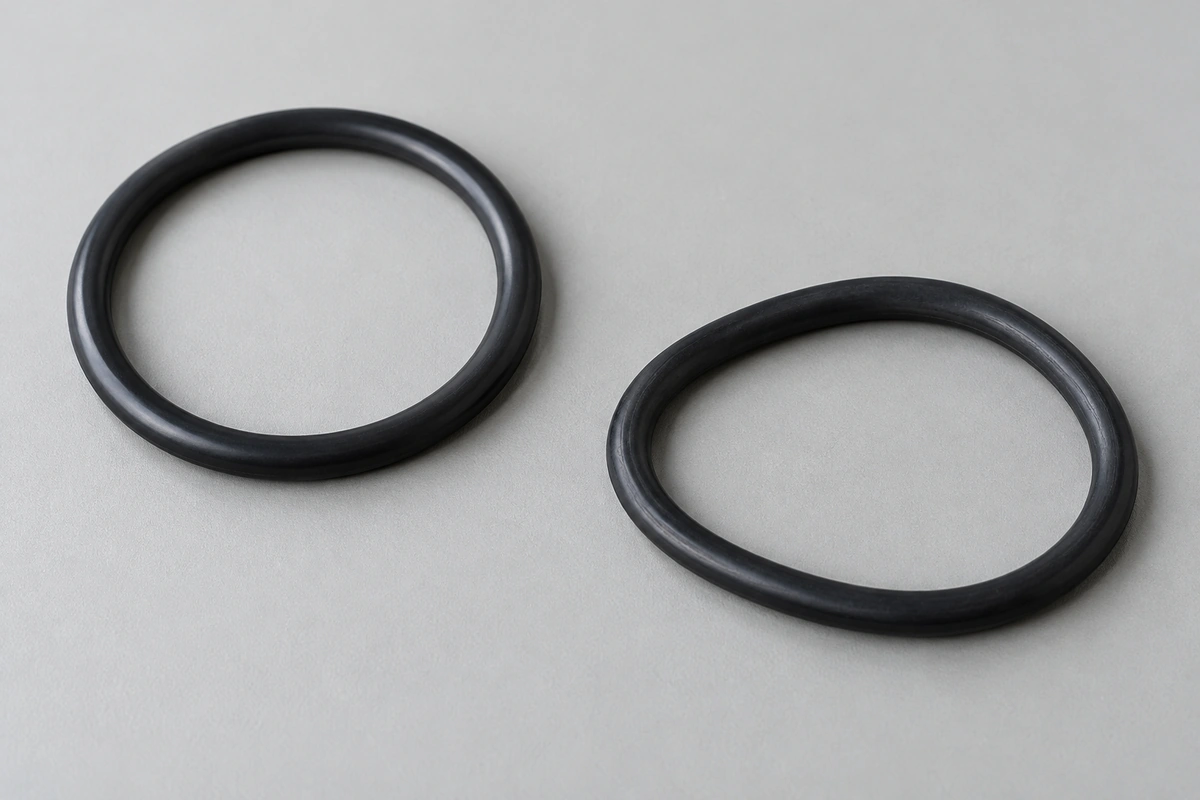
A loose seal found flattened under a tie or packed in a strained shape needs a condition record before anyone tries to make it look normal. The useful receiving question is whether the reported storage deformation can be assessed against the actual seal requirement. It is not how quickly the seal can be reshaped for a photograph.
Keep the seal identity, packaging arrangement and existing condition evidence together. No recovery time, deformation allowance or physical restoration method is supplied here.
Separate the package shape from the seal condition
Hallite’s storage guidance calls for rubber items to be kept relaxed, without tension or compression, and identifies permanent distortion among concerns for inspection after storage. That provides a reason to refer a documented distortion concern for assessment, not a visual rule for declaring every flattened item permanently damaged. Hallite storage of seals, deformation and post-storage inspection
Describe what the existing view establishes: a tie across a group, a flattened region, a folded package or an unclear profile. Distinguish the package pressure or arrangement from a conclusion about the seal material. The record should not claim an exact cause where the history is unknown.
Preserve identity through a bundled receipt
Identify the seal type, material declaration, order line and lot or package reference from the available records. If several different seals share a bag, ask the supplier to identify which references are involved. One affected bundle should not automatically represent every seal in the shipment.
Keep the original image and observation date distinct from later records. If someone has already unpacked or changed the arrangement, record what is known about that intervention. A later round-looking seal cannot recreate the original arrival evidence, and an apparently improved outline does not establish restored performance.
The assessment request should name the exact seal and material information available, the observed storage state and the evidence limits. Ask the manufacturer or competent provider to define what further authorized examination, if any, is needed. Do not propose stretching, heating, squeezing or a waiting period as an acceptance method.
Loose-seal distortion worksheet
| Field | Evidence to retain |
|---|---|
| Loose seal identity | Required designation, material record and received package or lot |
| Packed arrangement | Existing view of ties, folds or compression, without recreating it |
| Observed profile | Location and original description of flattening or distortion |
| History | Known packing/storage facts; unsupported duration left blank |
| Intervention record | What changed after arrival and who reported it |
| Assessment outcome | Exact scope reviewed, unresolved condition and authorized decision |
This worksheet concerns a loose component. If the seal is already fitted to a piston or other subassembly, its support-contact arrangement raises a different assembly-state question and should not be represented as a loose-seal bundle.
A fictional straighten-it reply
A fictional receiving image shows an identified loose seal bundle compressed beneath a fastening tie. The supplier says to reshape the parts and photograph them again. That response does not explain whether the original condition affects acceptance and would change the evidence under review.
Preserve the existing images and ask for a product-specific disposition or defined assessment route. If the provider cannot establish the condition from those records, document that limitation. A replacement, return or further assessment may be considered through the actual commercial agreement, without claiming a universal entitlement.
If a later assessment addresses only selected seals, keep its coverage explicit. A decision on one identified piece does not release an entire mixed bundle. Close the original distortion concern with its own record rather than replacing it with a tidy final photograph or an unsupported assurance of service life.
Prepare a bounded supplier question
Use the Seals and gaskets category and Spareparts sourcing request to identify the item and the unresolved question. Independent aftermarket or unbranded buying coordination does not establish manufacturer affiliation, original-equipment supply, inspection availability or technical approval. The manufacturer references above explain documentation; the fictional example is not a customer case.
The form supports a supported-marketplace HTTPS link, an 8–1200-character description, or screenshots. It accepts up to five PNG, JPEG, WebP or GIF images, at most 10 MiB each and 20 MiB combined. It does not accept PDF, CAD or ZIP uploads. Arrange other authorized technical files only through a separately agreed exchange.
Does a flattened outline prove permanent damage?
No. It is an observation requiring appropriate assessment. The article supplies no deformation limit or visual diagnosis.
Should a loose seal be reshaped before taking the receipt record?
Do not use reshaping as an evidence shortcut. Preserve the existing arrival record and seek product-specific guidance before any further handling or treatment.
How long should I wait for a seal to recover?
No universal recovery period is established. A competent provider must assess the actual product and condition; elapsed time is not an acceptance criterion here.
Does an improved later shape close the concern?
Not by itself. Record any intervention and obtain the required scoped disposition. A changed outline does not establish restored sealing performance.
Sources
Discuss a sourcing request related to this article.Loose seal receipt: document storage distortion