
Rotary union packing: review material near fluid openings
Separate cushioning from the risk of packing material entering a rotary union opening when a supplier changes the inner arrangement.
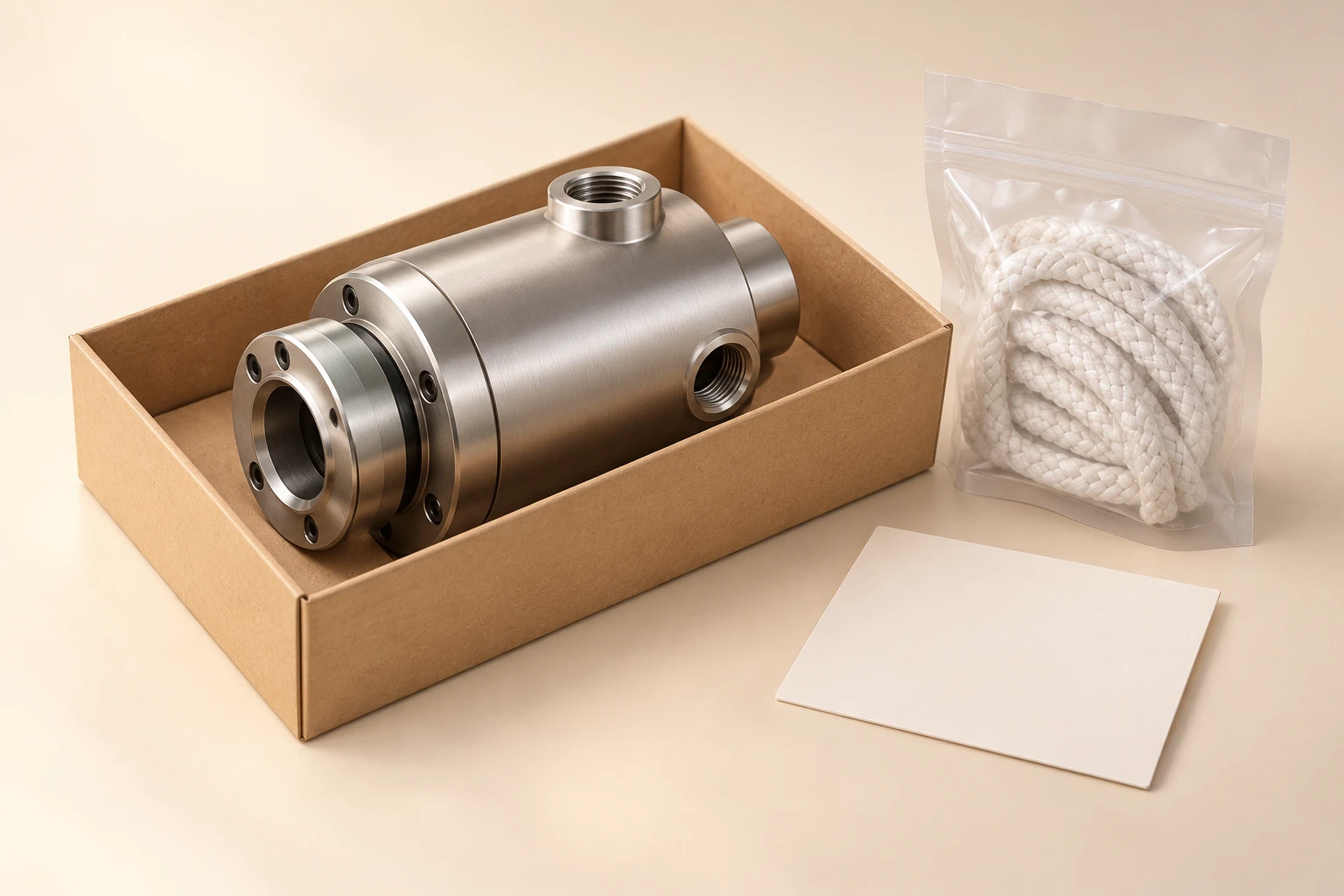
An intact outer carton does not answer whether packing material can reach a rotary union's openings. When a supplier changes cushioning or adds loose fill, review the material's relationship to the documented openings before accepting the revision. More padding is not automatically a more complete packing proposal.
Start with the rotary union already selected and its supplied condition identified. The decision here is whether the proposed packaging change addresses material ingress. It does not choose a closure, prescribe cleaning or establish the union's internal condition.
Keep the manufacturer's context attached
Deublin's operating manual 040-550 for series 54, 55 and 57, version 2017-07 Rev. Hi4, addresses packing for transport to Deublin in section 9.2. It specifically requires keeping packing material and dirt out of the union opening. This is a named-model service-transport context, not a universal packing certification for another union or a new-parts shipment. Deublin manual, section 9.2
Use that limited observation to ask the actual provider about its product and shipment. Obtain the applicable transport guidance rather than copying a sequence from the example manual. Product preparation, removal from equipment and handling of residual media belong to competent authorized providers under their own procedures.
Identify the opening state without disturbing it
Use the accepted model/configuration record to locate the relevant openings in the provider's proposal. Ask which are documented as closed in the supplied state, which are otherwise protected and which remain unclear. Keep the provider's terminology and evidence reference.
A package photograph may show a cover without identifying its role or suitability. Do not select a plug, tape or sealing material from that view. Missing opening-state evidence should produce a targeted question, not a request to uncover or probe the union.
Keep the product drawing and packaging drawing distinct. The first can identify an opening while the second describes nearby material. Neither automatically establishes that the new arrangement controls ingress during the intended shipment.
Describe what the cushioning change introduces
Ask what material is added, replaced or relocated, and where it sits relative to the openings in the proposed closed package. The term extra cushioning is insufficient when the changed material itself is the unanswered concern.
Request the exact material identity and an explanation from the responsible product or packaging provider covering the intended configuration. Do not assert that a material sheds particles merely because it looks fibrous, or that a soft material cannot cause an ingress problem. Record what is known and what has not been assessed.
Keep exterior impact protection and opening protection as separate response fields. Evidence addressing one does not necessarily address the other. Likewise, identifying the correct closure does not prove the surrounding packing arrangement is satisfactory.
A fictional loose-fill substitution
Suppose an approved rotary-union supply has an identified original packing arrangement. A consolidation proposal replaces part of that arrangement with an unspecified loose fill beside a documented opening. The supplier responds with a photograph of the sealed carton and says it is well cushioned.
The carton view does not resolve the changed inner relationship. Ask for the applicable opening-state record, the exact proposed material and the provider's response covering ingress in that arrangement. Keep the change pending while unrelated carton labeling can be reviewed separately.
If the supplier instead reports that material may already have entered the unit, the issue changes from proposed packing to possible supplied-condition contamination. Preserve that report and seek a product-specific disposition. Do not tell a packer to shake, flush, blow out or disassemble the union.
Use an opening-and-material change record
| Record field | Evidence to retain |
|---|---|
| Union configuration | Exact approved model and applicable transport guidance |
| Opening state | Provider-defined opening references and supplied closures or unknowns |
| Changed material | Exact cushioning/fill identity and revision being proposed |
| Inner relationship | Where the material sits relative to the documented openings |
| Separate evidence | Impact/cushioning response distinguished from ingress response |
| Disposition | Responsible provider decision and any changed-condition escalation |
This purchasing worksheet does not prove cleanliness, prescribe a test or certify transport. It connects a specific material change with the specific openings that require the responsible provider's attention.
The final packing acceptance should identify the covered model, supplied state, material and proposal issue. A later substitution of fill or a changed opening condition needs a new applicability check. Record any remaining ingress question rather than closing it under a general statement that the box is strong.
Bring the specific packing question into the inquiry
Use the Machined parts category and Spareparts sourcing request to identify the approved item and exact proposed change. The site provides independent aftermarket/unbranded buying coordination and supplier negotiation. Manufacturer examples do not establish affiliation, original-equipment supply, specialist packing capability or engineering approval.
The initial form supports an eligible marketplace HTTPS link, an 8–1200-character description or screenshots. It accepts up to five PNG, JPEG, WebP or GIF images, at most 10 MiB each and 20 MiB combined. PDF, CAD and ZIP files need a separately agreed authorized exchange; the image field is not a technical-file portal.
Does a strong carton prove the openings are protected?
No. Exterior cushioning and the material relationship at openings are separate questions. Obtain evidence for the actual inner arrangement.
Can I copy the Deublin packing sequence for another union?
No. The cited section concerns named series and service transport to Deublin. Obtain the actual product provider’s applicable guidance.
Should a packer clean out suspected packing fragments?
This article gives no cleaning or disassembly instructions. Record the concern and seek the responsible provider’s scoped disposition.
Is an original cap enough to approve new loose fill?
It can help establish the supplied closure identity, but the changed material and configuration still need an applicable provider response.
Sources
Discuss a sourcing request related to this article.Rotary union packing: review material near fluid openings