
Cleanroom Hose Kits: Keep the Destination Bag Layer in the Supply Scope
Check whether a hose-kit simplification retains the separately specified destination bag layer and its actual provider support.
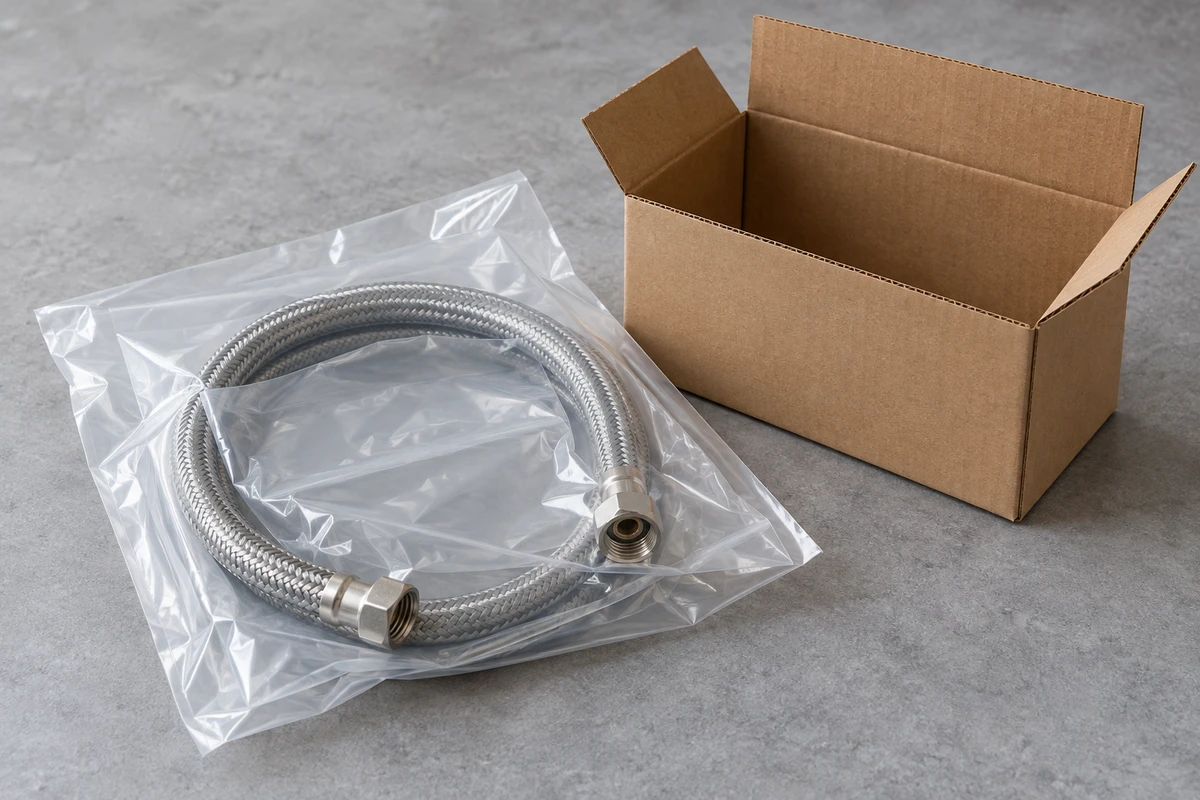
A hose kit can leave every hose inside a closed bag and still omit a packaging layer the destination requires. When reviewing a cheaper or simpler kit proposal, identify which bag serves delivery and which separately specified layer serves the receiving facility's requirements. Counting closed bags does not establish that both purposes remain covered.
Begin with an existing requirement from the destination owner. This article helps define the purchased packaging scope; it does not prescribe cleanroom entry, bag removal, cleaning or handling procedures.
Attribute the example to its actual provider
In an article dated 10 November 2016, Swagelok Northern California describes its own hose assembly orders as individually bagged. It also describes optional double bagging where one bag serves delivery and another serves cleanroom entry. This is a historical statement by that assembly provider, not a universal Swagelok factory specification or a current offer from another seller. Swagelok Northern California hose article
Confirm current availability and the exact specification with the actual provider. The example explains why two layers can have distinct purposes. It does not establish cleanliness, sterility or suitability for a particular destination.
Swagelok's UHP tubing catalogue separately describes individually double-bagged tubes within a further bulk bag. That is a tubing-specific example of nested levels, not a hose packaging instruction. No tubing cleanliness class or process specification is transferred here. Swagelok tubing catalogue, packaging table on printed page 2
Name the destination requirement before comparing layouts
Ask the receiving facility's responsible owner to identify the applicable packaging requirement and revision for the accepted hose assembly. A request merely saying cleanroom packed leaves the provider to interpret both the product scope and the required output.
Separate the requirement from the seller's description of its standard supply. If the seller confirms only an individual delivery bag, the destination layer remains unanswered where it was separately specified. Do not fill that gap by attaching a catalogue paragraph about another product.
Keep the record at supply level. The buyer needs the provider's accepted layer description and the destination owner's decision on any variation. The record need not reproduce the facility's operational procedure or instruct a packer when to remove a layer.
Ask what the simplification removes
A proposal might reduce individual layers, replace them with one shared kit bag, or change only the outer transport carton. These are different scope changes. Have the provider identify the affected level and the purpose it says will remain covered.
A shared outer bag does not automatically replace a separately specified bag for each hose. Its acceptance depends on the actual requirement and authorized response. Likewise, an unchanged count of bags does not prove equivalence when one proposed layer belongs to the whole kit instead of each item.
| Supply-map field | Question to resolve |
|---|---|
| Assembly reference | Which approved hose and order line does this cover? |
| Delivery layer | What does the provider actually promise? |
| Destination layer | Which separate requirement applies to each hose? |
| Shared outer level | Is it additional packaging or a proposed substitution? |
| Change | Which agreed purpose would lose its identified layer? |
| Authority | Has the provider and destination owner accepted this exact variation? |
| Open item | What information is still missing before purchasing approval? |
The map is an original editorial purchasing tool. It is not a cleanroom standard, a test method or evidence that a supplier can perform specialist packaging.
Work through a fictional one-bag proposal
Suppose an invented kit specification requires separate delivery and destination bag layers for each accepted hose assembly. A lower-cost proposal keeps each hose in one bag and places all of them in a common outer kit bag. No real price, supplier or performance result is represented.
The proposal preserves individual enclosure, but it changes the specified destination layer. Ask the provider to state that change explicitly and the destination owner to decide whether it can satisfy the requirement. A photograph of closed bags would not answer the scope question.
If the destination owner accepts an identified alternative, retain that decision and the provider's confirmation of the revised supply. If the response covers only transport protection, the destination requirement remains open. The buyer can request the specified arrangement or seek another supported offer without assuming either is available.
Compare the price only after the scope is clear
Put the original and proposed layer maps beside the commercial offers. Identify any separately quoted specialist packaging or documentary output, without inventing the provider's cost or assuming savings. Removing a required deliverable is a scope reduction; it is not evidence that the same kit has become cheaper.
Once a supply map is accepted, retain the exact issue with the purchase. A later proposal to combine individual layers should return to the same responsible owners. This keeps procurement focused on the promised output while leaving facility operations and technical acceptance with their qualified owners.
For broader product context, see seals and gaskets. A spare-parts inquiry can identify the current layer requirement and proposed change. We provide independent aftermarket and unbranded buying coordination and supplier negotiation; no cleanroom facility, branded-supply offer or relationship with the example provider is implied.
The initial inquiry supports an eligible marketplace HTTPS link, an 8–1200-character description or screenshots. It accepts up to five PNG, JPEG, WebP or GIF images, at most 10 MiB each and 20 MiB total. PDF, CAD and ZIP files need a separately agreed authorized exchange; the image field is not a technical-file portal.
Is any closed hose bag enough for cleanroom entry?
Not by itself. The relevant question is whether the actual supplied arrangement meets the receiving facility’s identified requirement. A closed delivery bag may leave a separately specified destination layer unanswered; only the responsible provider and destination owner can resolve the proposed scope.
Can one common outer kit bag replace each hose’s specified second bag?
Do not assume that substitution is equivalent. Identify the individual layer being removed, the function attributed to the shared layer and the exact destination requirement. Retain an authorized decision on that variation before treating it as the accepted supply.
Does double bagging prove sterility?
No. A bag count does not establish sterility, cleanliness performance or destination suitability. The historical provider example explains distinct packaging purposes and supplies no certification or universal acceptance rule.
Can tubing packaging instructions be reused for hoses?
No. The tubing catalogue is a product-specific example of nested packaging levels. Its specifications do not establish a hose provider’s capability or authorize hose packaging, cleanroom transfer or handling procedures.
Sources
Discuss a sourcing request related to this article.Cleanroom Hose Kits: Keep the Destination Bag Layer in the Supply Scope