
Wave spring receipt: distinguish preset state from damage
Resolve a wave spring height concern against its ordered preset state before interpreting a supplier explanation or accepting the received spring.
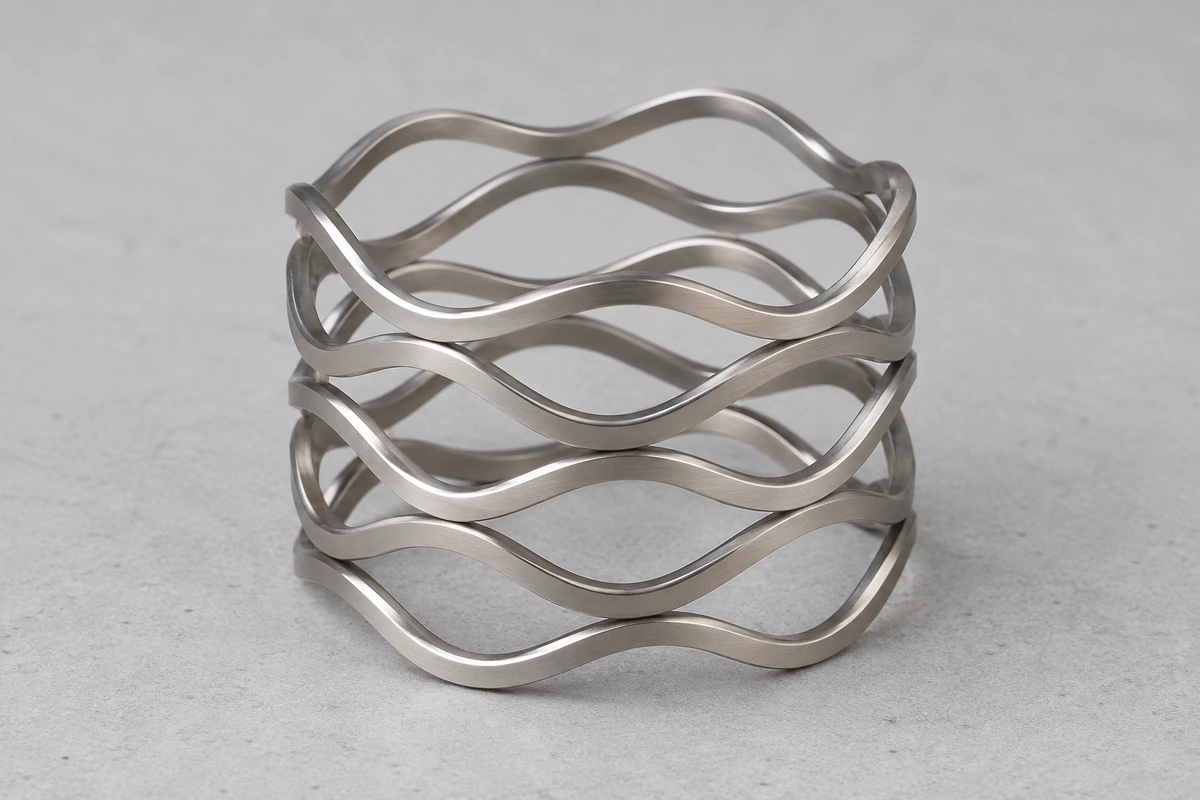
A wave spring that appears shorter than a catalogue illustration has not necessarily been crushed in transit. It also has not necessarily passed inspection. First establish whether the order and the comparison record describe the same manufacturing state. Presetting makes that question particularly important for wave springs.
This receiving review decides which requirement and manufacturing declaration belong to the delivered spring. It does not tell a buyer to compress a spring, determine its load capacity or judge service fitness from its outline.
Separate the two height references
Smalley explains that preset wave springs begin with a higher free height and load, and that presetting reduces both. That is a manufacturing-state distinction in its spring guidance, not permission to reinterpret an unexplained dimensional departure as normal. Smalley wave spring performance
Locate the approved part reference, drawing revision and any presetting requirement. Ask whether the cited free-height information describes the spring before or after the specified manufacturing process. Preserve the supplier's original wording if that state is not identified. A catalogue sketch, a manufacturing record and an incoming measurement may concern different states even when they carry the same family name.
The acceptance reference must come from the actual order and responsible technical owner. Do not substitute a pre-process illustration for a released delivered-state requirement, or adjust an acceptance limit yourself to allow an assumed amount of set.
Ask for the process declaration that matters
Request the supplier's attributable statement of the delivered manufacturing state, linked to the received lot or item. Ask which document supports that statement and which height reference it uses. A generic explanation of what presetting does cannot show that this particular spring underwent the ordered process.
Keep any actual incoming report separately. Its result remains the reported result; the supplier's explanation does not change the number. The qualified reviewer must decide whether the process state, requirement and result are comparable, and whether further authorized evidence is needed. This is different from asking for a force at a specified operating deflection: here the open question is which production state was delivered.
Use a preset-state receipt worksheet
| Field | Entry needed for this decision |
|---|---|
| Received spring | Exact order line, part reference and attributable lot or item |
| Ordered state | Preset requirement or explicit unresolved state, with accepted reference |
| Height reference | Document revision and whether it describes pre-process or delivered state |
| Supplier declaration | Claimed actual process state and record linking it to these springs |
| Incoming concern | Original observation or report; no inferred damage classification |
| Disposition | Reviewer’s state comparison, remaining evidence and scoped outcome |
Do not use the worksheet as a load-test plan. It keeps a process question visible without converting a visual concern into a manufacturing diagnosis.
A fictional short-spring concern
Imagine an order explicitly calling for a preset spring. Receiving compares it with a supplier's earlier unpreset illustration and records a height concern. The supplier answers only, “Preset springs are shorter.” That explanation describes a possibility, but leaves the batch and drawing relationship unproven.
Ask for the applicable delivered-state document and lot-linked manufacturing declaration. If those records establish that the wrong comparison reference was used, correct the reference history while preserving the original concern. The actual receipt result still needs review against the governing requirement. If the order never specified a state, record the missing definition rather than inventing one after arrival.
Close with the specific spring population, accepted state and responsible decision. An explained height difference is not a blanket release for load performance, fatigue life or an entire shipment.
Prepare a bounded supplier question
Use the Machined parts category and Spareparts sourcing request to identify the item and the unresolved question. Independent aftermarket or unbranded buying coordination does not establish manufacturer affiliation, original-equipment supply, inspection availability or technical approval. The manufacturer references above explain documentation; the fictional example is not a customer case.
The form supports a supported-marketplace HTTPS link, an 8–1200-character description, or screenshots. It accepts up to five PNG, JPEG, WebP or GIF images, at most 10 MiB each and 20 MiB combined. It does not accept PDF, CAD or ZIP uploads. Arrange other authorized technical files only through a separately agreed exchange.
Does a lower free height prove transit damage?
No. The comparison may concern a different manufacturing state. Establish the ordered state and applicable reference, then have the actual observation reviewed; neither damage nor conformity follows from height appearance alone.
Does a generic presetting explanation prove my lot was preset?
No. Ask for an attributable manufacturing-state declaration connected to the received spring population and the relevant requirement.
Can receiving compress the spring to confirm its state?
This worksheet authorizes no compression or load test. Any physical verification needs an appropriate technical owner, method and agreed scope.
What if the order never mentions presetting?
Leave the state unresolved and ask the requirement owner to clarify it. Do not retrospectively create a preset allowance or call an undefined state an accepted match.
Sources
Discuss a sourcing request related to this article.Wave spring receipt: distinguish preset state from damage