
Braided-packing RFQ: retain impregnation and lubricant details
Compare braided packing by its specified fiber construction, impregnation and lubricant declaration instead of relying on a broad fiber label.
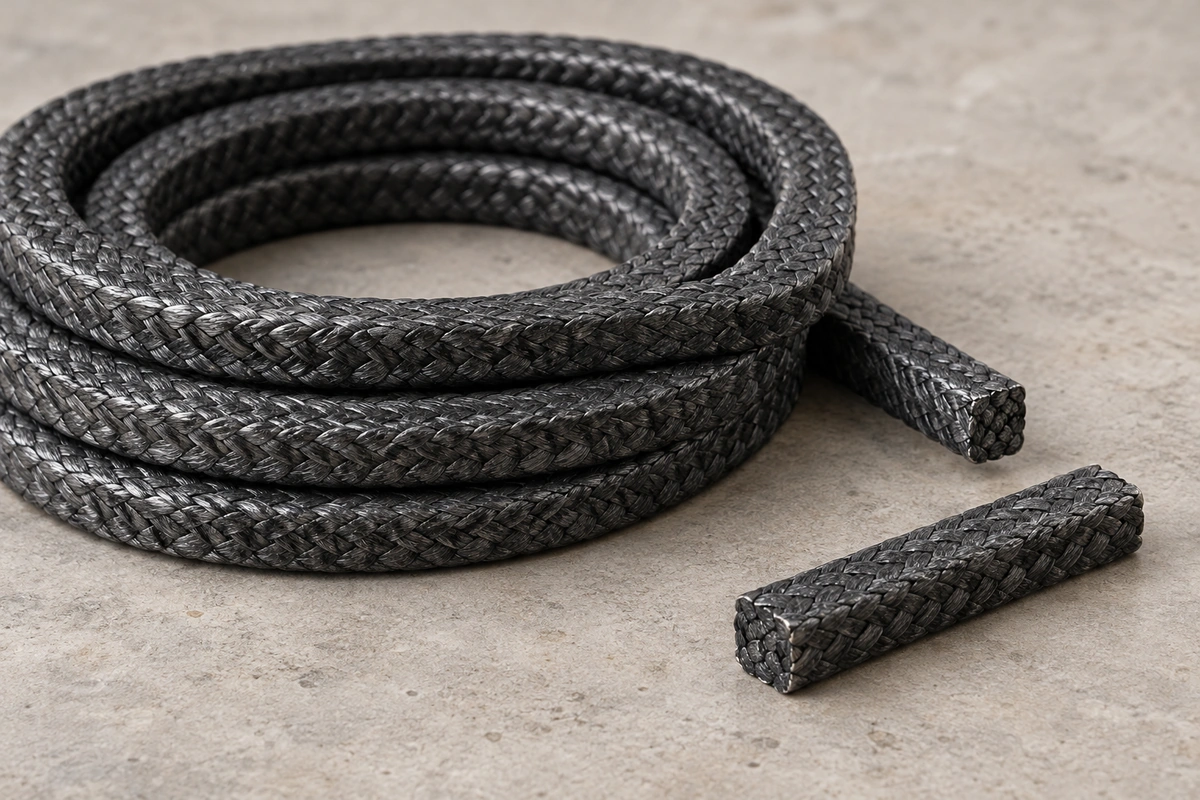
“Aramid packing” identifies only part of a possible purchasing requirement. If the released packing specification also names an impregnation and lubricant system, an offer that omits those details has not confirmed the same material construction.
The buyer's task is to preserve the specified formulation boundary and make differences visible. It is not to choose packing from a generic list of fibers or infer chemical compatibility from a spool's appearance.
Read beyond the fiber name
EagleBurgmann describes Araflon 6426 using aramid fibers, PTFE impregnation and a lubricant additive. The description shows that the fiber and the treatments are separate parts of a named packing construction. It does not establish that an unbranded braid labelled aramid has the same composition or suitability. EagleBurgmann packings and gaskets, Araflon 6426 entry
Use that distinction to structure the request: fiber identity and braid construction; impregnation system; lubricant declaration; exact product designation. Where the approved record specifies additional restrictions, retain them as requirements rather than assuming the named fiber satisfies them.
Do not convert a supplier's broad phrase such as “PTFE treated” into a complete declaration. Ask what documented product it describes and which requested fields it answers. If the formulation is proprietary, ask for an adequate product specification and application assessment; purchasing does not need to invent undisclosed percentages.
Recover the actual service requirement
Identify the machine or valve, the packing reference and the approved service conditions from existing records. Distinguish the requirement from an as-found sample, especially where a previous maintenance replacement may have used a different packing.
Have the responsible specialist decide what information is needed about the medium, temperature, motion and other duty conditions. Supplier family-level limits should not be copied into the application column as if they were measured operating data. Likewise, a page listing an industry is not proof of approval for every process in that industry.
Where product contamination or a restricted substance is relevant, make the exact requirement explicit and request suitable evidence. A lubricant-free statement and a statement excluding one named lubricant are not interchangeable. Do not claim compliance from an omitted ingredient in a short sales description.
Keep size and formulation as separate responses
The quote needs the specified section dimensions and supply quantity, but a correct section size does not close the composition question. Ask the seller to return a technical product identity as well as the commercial unit: length, mass, spool or other stated basis.
If the supplier proposes another braid because the original is unavailable, ask for a deviation statement that identifies changed fiber, impregnation and lubricant fields. “Same size and stronger” is not a field-by-field response. The technical approver may need additional evidence before deciding whether the alternative is a candidate at all.
A fictional substitution hidden in a short title
An approved record names an aramid packing with a documented impregnation and lubricant system. Offer A confirms the section size and says “aramid, PTFE.” Offer B identifies a different named packing with a different lubricant declaration.
Ask A for its exact designation and missing treatment details. Send B as a declared alternative to the technical owner. Do not treat B's more complete paperwork as automatic acceptance, but recognize that it makes the difference visible. No real packing performance or price advantage is asserted in this example.
Use a construction-and-treatment worksheet
| Record field | What the buyer should preserve |
|---|---|
| Packing designation | Exact required and offered product, with source document revision |
| Fiber construction | Specified fiber and braid description, retaining unknown details |
| Impregnation system | Documented treatment identity, not an inferred formula |
| Lubricant declaration | Required declaration and supplier response, including specific restrictions |
| Service evidence | Approved duty record and application assessment requested from the responsible party |
| Deviation status | Changed fields, evidence missing and technical decision for the exact alternative |
Record the source for each answer. If a supplier cannot disclose a requested detail, write “not provided” and let the technical owner determine whether other evidence can resolve the requirement. Do not convert an unanswered field to “same as original.”
Ask for a traceable product response
A useful inquiry reads: “Quote the packing designation and section in our record. Confirm fiber construction, impregnation and lubricant declarations against the referenced specification. Identify every proposed difference and provide the relevant product data for review. State the supply unit and quantity separately.”
Use the seals and gaskets category and spare-parts inquiry to start the sourcing discussion. This documentation process does not provide packing installation, adjustment or pressure-testing instructions, and it does not transfer a manufacturer's claim to an unidentified substitute.
The inquiry image field accepts up to five PNG, JPEG, WebP or GIF files, no more than 10 MiB each and 20 MiB combined. A supported marketplace link, a short description or screenshots can start the request. It is not a PDF, CAD or ZIP upload field; arrange other technical files through a separately agreed, authorized exchange.
Is the fiber name a complete packing specification?
Usually it leaves other requested fields unanswered. Preserve the approved impregnation, lubricant, construction and dimensional requirements as well as the fiber identity.
Does “PTFE treated” confirm a particular packing formulation?
Not by itself. Ask for the exact product designation and documentation identifying the treatment and other required declarations.
What if the supplier will not disclose a proprietary formulation?
Record what is unavailable and request an adequate product specification or manufacturer assessment. The technical owner must decide whether the evidence satisfies the requirement.
Can a matching section size justify a different lubricant system?
No. Size and formulation are separate comparisons. A changed lubricant system must remain a stated deviation until appropriately reviewed.
Sources
Discuss a sourcing request related to this article.Braided-packing RFQ: retain impregnation and lubricant details