
Fabric expansion-joint RFQ: define the renewal boundary
Separate fabric-only renewal from a preassembled replacement and identify which existing frames and associated parts the quote assumes will remain.
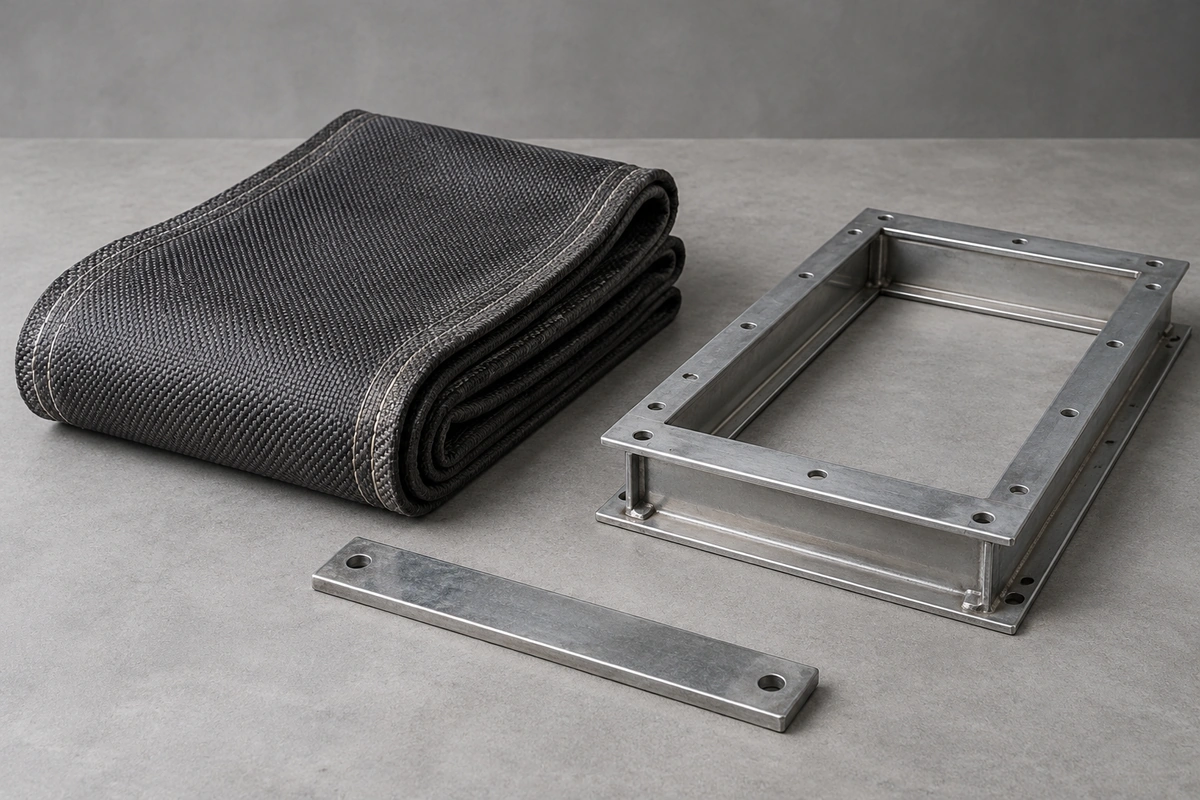
A fabric-only renewal price and a preassembled expansion-joint price cover different purchasing boundaries. Before choosing between them, identify which existing frames and associated parts the fabric-only proposal assumes will remain, and who is responsible for assessing them.
This is a scope decision before it is a unit-price comparison. The buyer needs an explicit list of supplied and retained items, tied to the existing assembly, rather than a generic statement that the new fabric fits the opening.
Read the supply form literally
EagleBurgmann's Flexgen and Fluachem entries describe supply as fabric only or as a preassembled unit, with the products tailored to working conditions. These named examples show that “expansion joint” can refer to different supply forms. They do not establish reuse suitability for the reader's frame or approval for a substitute fabric system. EagleBurgmann fabric expansion-joint entries
Ask the seller which form its quoted price represents. A photograph of a complete assembly does not prove that the frame, associated parts or technical services are included. Conversely, a fabric-only quote may be appropriate to an approved renewal plan, but that plan must exist independently of the attractive price.
Start with the actual installed unit
Collect the expansion-joint identifier, arrangement drawing, revision and the responsible equipment or duct-system record. If previous renewals have changed the construction, distinguish the original documentation from the current approved arrangement.
Ask the technical owner to identify the working conditions and movement requirements that govern the replacement. A cut size or visible opening alone is not the application brief. If records are missing, request a scoped assessment rather than asking a seller to select a fabric construction from a photograph.
Keep condition evidence separate from dimensional identity. The fact that a frame is the original one does not establish that it remains acceptable for reuse. The RFQ should name the competent party who will assess it and the point at which that assessment must be available.
List every retained assumption
Build a component list from the assembly record. For each relevant frame, attachment component, liner, insulation element or other associated part shown there, identify whether it is supplied new, retained subject to review, optional, excluded or unresolved. These examples are prompts to check the drawing, not a universal bill of materials.
Ask the supplier to state dependencies. If its fabric-only price assumes an accepted existing frame or a separately supplied component, preserve that assumption in the quote. A blank line should not become an implicit promise that someone else will provide it.
For a preassembled proposal, request the drawing and exact assembly contents. “Complete” still needs a definition. Ask what site work, condition assessment, installation and acceptance services are excluded rather than assuming a supplied assembly includes all of them.
Compare a fictional renewal pair
Offer A supplies a replacement fabric element and assumes the existing frame and associated components can remain. Offer B supplies a defined preassembled unit. The buyer has not yet arranged a condition review of the existing frame.
A is a conditional renewal proposal, while B has a different material boundary. Ask A to preserve its reuse assumptions and ask the responsible specialist what evidence will resolve them. Compare total scoped proposals only after the renewal route is established. This invented example does not recommend replacement of a sound frame or reuse of a damaged one.
Use a renewal-boundary worksheet
| Record field | What the buyer should preserve |
|---|---|
| Existing unit identifier | Installed assembly and approved revision, distinguishing later changes |
| Fabric-only or unit | Exact supply form represented by the quoted price |
| Retained frame record | Frame identity, condition-review status and responsible assessor |
| Included associated parts | Drawing-based list of new, retained, optional, excluded or unresolved items |
| Condition-review owner | Party and evidence required before reuse assumptions are accepted |
| Approved renewal boundary | Final included/retained scope and the decision authorizing that route |
Attach the component list and the condition-review reference. If the assessment changes what can be retained, revise the quotation boundary before order release instead of relying on an old fabric-only price.
Put the scope in the inquiry
“Please state whether this is a fabric-only renewal or a defined preassembled unit. Identify all included items, all existing parts assumed to remain and the supporting arrangement drawing. List unresolved condition and application inputs. Quote additional components separately until the renewal boundary is approved.”
Use the seals and gaskets category and spare-parts inquiry to organize the request. Material selection, retained-part assessment and installation acceptance remain with the qualified system owner or provider. No fabric cutting, mounting or operational procedure is supplied here.
The inquiry image field accepts up to five PNG, JPEG, WebP or GIF files, no more than 10 MiB each and 20 MiB combined. A supported marketplace link, a short description or screenshots can start the request. It is not a PDF, CAD or ZIP upload field; arrange other technical files through a separately agreed, authorized exchange.
Does a fabric-only offer include the frame?
Do not assume it does. Ask for the exact included items and a separate list of existing components the proposal expects to retain.
Can matching fabric dimensions prove the renewal is suitable?
No. The construction, working conditions, movement requirements and retained-component condition need their own competent review.
Is a preassembled unit always the better choice?
This article makes no universal recommendation. Compare the approved renewal options and complete scope after the relevant condition and application questions are resolved.
What happens if the frame condition is still unknown?
Keep a fabric-only offer conditional. Name the assessor and required evidence, then update the quotation if the accepted retention boundary changes.
Sources
Discuss a sourcing request related to this article.Fabric expansion-joint RFQ: define the renewal boundary