
Mechanical-seal RFQ: define the rotation viewing reference
Resolve direction dependence and the manufacturer’s viewing reference before accepting a clockwise or anticlockwise seal quotation.
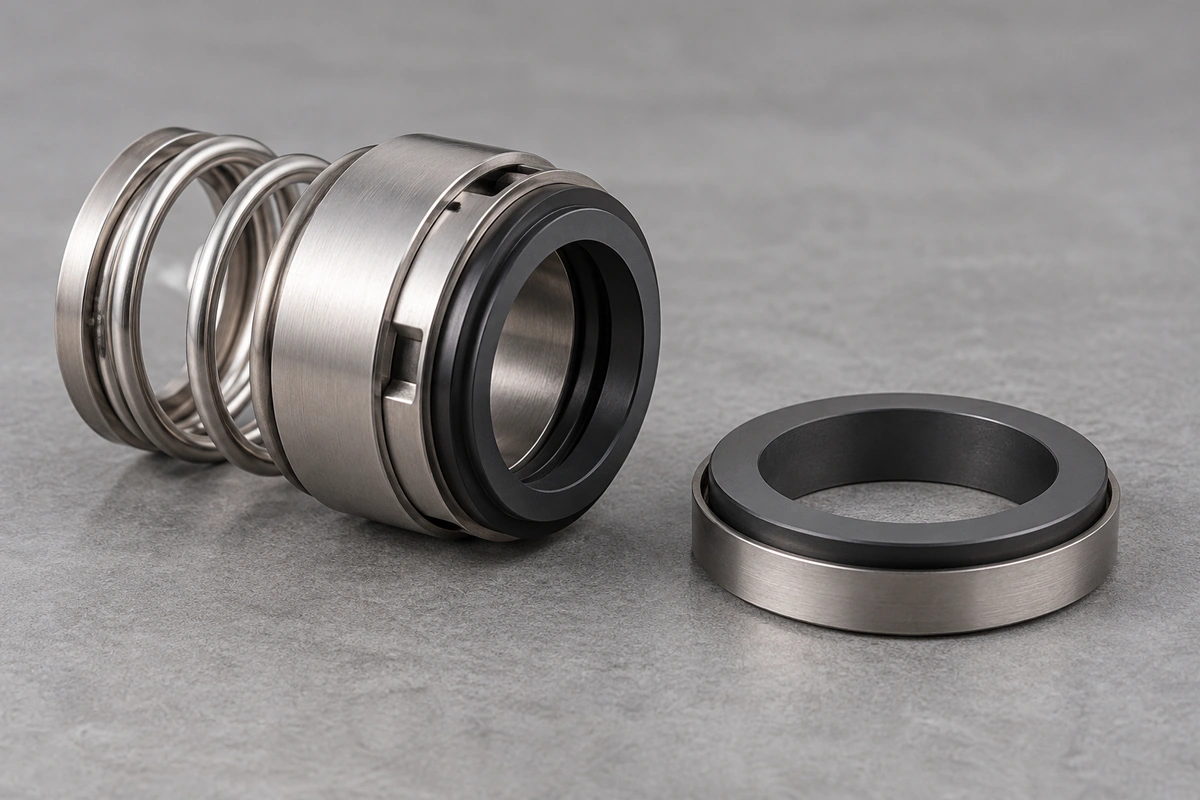
“Clockwise seal” is an incomplete answer if the supplier and buyer are looking from opposite ends. A useful mechanical-seal RFQ identifies whether the exact model depends on rotation direction and preserves the manufacturer's reference for interpreting that direction.
The goal is a documented match between the equipment record and the proposed seal. It is not an invitation to run the machine to observe rotation, infer spring behavior from a photograph or change the drive direction to suit a part in stock.
First establish whether direction matters for this model
EagleBurgmann describes its BT-FH as direction-dependent, with torque transmitted through a rotating conical spring. The BT-AR page, by contrast, describes that model as independent of direction of rotation. These are bounded product examples showing why a buyer must check the exact seal instead of applying one rule to all mechanical seals. BT-FH features and BT-AR features
Record the manufacturer's actual statement for the offered variant. If the supplier claims direction independence, ask for the document that establishes it for that product. Absence of a direction field in a marketplace listing is not the same as a documented direction-independent design.
Keep direction and viewpoint in one field
Use the equipment manufacturer's record to establish the required rotation and its stated viewpoint. Ask the seal supplier for its own reference drawing or written convention. The comparison should show both references, not only two matching abbreviations.
A drawing arrow without a visible viewing reference may need clarification. So may an old note saying “CW” with no explanation of where the observer is positioned. Preserve these as unresolved observations rather than translating them into a confident purchase designation.
The source pages establish model-level direction dependence, but they do not resolve the viewing convention for every possible offered part. If the current model documentation does not state the convention, ask the actual manufacturer or qualified equipment service provider. The RFQ should not supply a universal viewing rule of its own.
Separate installed identity from historical identity
An original parts list and a more recent replacement invoice may describe different seal models. Record both and ask which reflects the approved current arrangement. A previous substitute does not automatically become the baseline simply because it was found in the machine.
Use already available manuals and safely accessible identification records. If more evidence requires dismantling or an operational check, leave that work to the responsible maintenance personnel under their approved procedure. The purchasing sheet should request a confirmed record, not prescribe how to obtain it from moving equipment.
Material selection and dimensions still require their own checks. A resolved rotation reference answers this particular question; it does not establish that a seal is otherwise interchangeable or suitable for the process.
A fictional disagreement that may be only a viewpoint problem
Suppose a machine record says clockwise from a defined equipment view, while a seal quote says anticlockwise without naming its view. The buyer cannot yet conclude either that the seal is wrong or that the words describe the same physical rotation.
Return the quote for its model-specific convention and have the technical owner reconcile the two references. If the offered model differs from the released model, also request its direction-dependence statement. Do not ask the supplier to change the label merely to match the order wording. This example contains no actual rotation recommendation.
Use a direction-reference worksheet
| Record field | What the buyer should preserve |
|---|---|
| Seal model | Exact required and offered variant, with differing historic records retained |
| Direction dependence | Manufacturer statement for the proposed model, or explicitly unresolved |
| Manufacturer view reference | Drawing or text defining the viewpoint behind the direction designation |
| Machine direction record | Approved equipment reference including its own viewpoint |
| Unresolved observation | Unlabelled arrow, uncertain abbreviation or unsupported model claim |
| Approver | Responsible person reconciling both references for the exact proposal |
A completed record should let another reviewer understand the orientation without relying on a telephone explanation. Store the reference drawing with the final decision and identify any handwritten annotation as an annotation, not original manufacturer content.
Phrase the inquiry around evidence
“Please state whether the exact seal variant offered depends on rotation direction. Provide the manufacturer's viewing reference and reconcile your designation with the equipment record supplied. Keep an unknown viewpoint open and identify any model substitution separately.”
The seals and gaskets sourcing category provides the purchasing context. Begin through the spare-parts inquiry, with only authorized documents or images. The equipment's responsible technical owner must approve the direction match; a buying agent's transcription is not that approval.
The inquiry image field accepts up to five PNG, JPEG, WebP or GIF files, no more than 10 MiB each and 20 MiB combined. A supported marketplace link, a short description or screenshots can start the request. It is not a PDF, CAD or ZIP upload field; arrange other technical files through a separately agreed, authorized exchange.
Is clockwise enough information for a seal RFQ?
No. It must be tied to a defined viewing reference and the exact seal model’s direction requirements.
Are all mechanical seals direction-dependent?
No. The cited BT-FH and BT-AR pages describe different direction characteristics. Verify the actual offered model rather than generalizing.
Can a spring photograph resolve the required rotation?
Do not treat it as authoritative evidence. Request the model documentation and the equipment’s approved rotation record.
What if the manufacturer’s viewing convention is unavailable?
Keep the direction match unresolved and ask the actual manufacturer or qualified equipment service provider. Do not invent a universal convention or authorize an operating check from this RFQ.
Sources
Discuss a sourcing request related to this article.Mechanical-seal RFQ: define the rotation viewing reference