
Wave spring shim ends: check the supplied end form
Reconcile the ordered wave spring end form with the delivered configuration without assuming matched envelope dimensions prove the same contact arrangement.
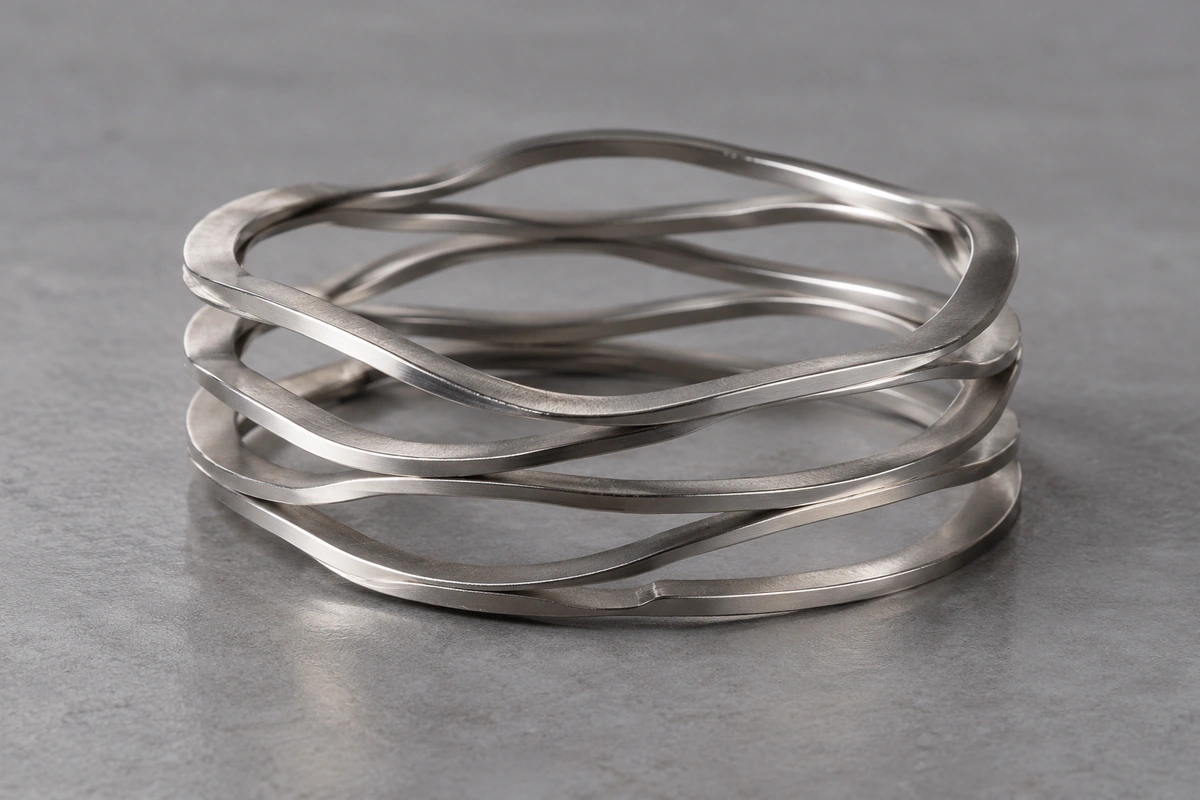
A wave spring with the expected diameter and height can still arrive with the wrong end configuration. If the order calls for shim ends, the receiving question is whether that defined form was supplied. A plain-ended spring should not disappear into a generic “same size” confirmation.
Use the approved part drawing and exact designation to establish the requirement. This article identifies a configuration discrepancy; it does not select an end form, approve an alternative or describe attachment methods.
End form changes the contact description
Smalley distinguishes squared-shim ends, which provide a full circumferential contact surface, from the wave-point contact of plain ends on its Crest-to-Crest springs. That is the product-specific reason to retain end form as a separate identity field. It is not evidence that either option fits an unnamed assembly. Smalley Crest-to-Crest springs with shim ends
Preserve the drawing’s wording rather than substituting “flat spring” or “washer end.” If a separate component appears in the assembly drawing, keep its identity separate from the spring’s own end form. Do not assume that adding a loose washer reproduces a specified shim-ended spring.
Compare configuration before negotiating a substitute
Ask for the exact supplied product designation and applicable drawing, linked to the received package or lot. Compare the end-form statement with the accepted reference. Existing images can help locate a visible difference, but they should not become dimensional proof or a contact-pressure assessment.
If a cropped view conceals one end, say the evidence does not establish it. Do not ask receiving staff to compress, separate turns or install the spring to expose a feature. A competent provider can define any necessary further assessment under an agreed scope.
A supplier reply that confirms only outside diameter, inside diameter and height leaves the end-form question open. Those values answer other requirements. Ask the supplier to address the identified end configuration explicitly, even if all the envelope dimensions match.
End-form receipt worksheet
| Field | What to retain |
|---|---|
| Ordered spring | Exact designation, drawing revision and end-form note |
| Supplied spring | Attributable designation and supplier’s configuration document |
| End evidence | Original views or report covering the relevant ends, with limitations |
| Mating context | Approved assembly reference explaining the specified interface |
| Proposed change | Plain-end substitution or other departure stated separately |
| Owner’s decision | Accepted configuration or open change review for the exact population |
The mating-context field records an existing requirement. It does not invite a purchaser to redesign the adjoining parts around whatever spring is available.
A fictional same-envelope substitute
Imagine a fictional order for a documented shim-ended spring. The supplier delivers a plain-ended variant with matching advertised envelope dimensions and calls it equivalent. The buyer can acknowledge the dimensional claims while identifying the end-form departure.
Request the alternative’s own drawing and an explicit difference statement. The technical owner must decide whether it can be considered in the approved assembly. If the supplier proposes adding separate washers, that is a changed assembly proposal with additional component identities, not an administrative correction to the delivered spring description.
If the original order used only a family photograph without an end-form designation, recover the accepted configuration before alleging a wrong supply. A missing requirement and an evidenced substitution need different commercial responses.
Close with the actual end form, reference and decision owner. A configuration match does not establish force performance, fatigue life or suitability of attachment to another component. Preserve those separate prerequisites rather than treating a clearer photograph as complete engineering acceptance.
Prepare a bounded supplier question
Use the Machined parts category and Spareparts sourcing request to identify the item and the unresolved question. Independent aftermarket or unbranded buying coordination does not establish manufacturer affiliation, original-equipment supply, inspection availability or technical approval. The manufacturer references above explain documentation; the fictional example is not a customer case.
The form supports a supported-marketplace HTTPS link, an 8–1200-character description, or screenshots. It accepts up to five PNG, JPEG, WebP or GIF images, at most 10 MiB each and 20 MiB combined. It does not accept PDF, CAD or ZIP uploads. Arrange other authorized technical files only through a separately agreed exchange.
Do matching spring dimensions prove the same end form?
No. Keep shim-end or plain-end configuration as a separate requirement with its own attributable product document.
Can loose washers replace specified shim ends?
Do not assume equivalence. That would be a changed assembly proposal requiring an explicit technical review and approval.
What if an image shows only one end?
Record its coverage limit and request applicable product documentation or appropriately authorized evidence. Do not infer the hidden configuration.
Does a shim-end match establish spring performance?
No. It resolves one configuration field. Required load behavior, application suitability and other acceptance questions retain their own evidence and responsible reviewer.
Sources
Discuss a sourcing request related to this article.Wave spring shim ends: check the supplied end form